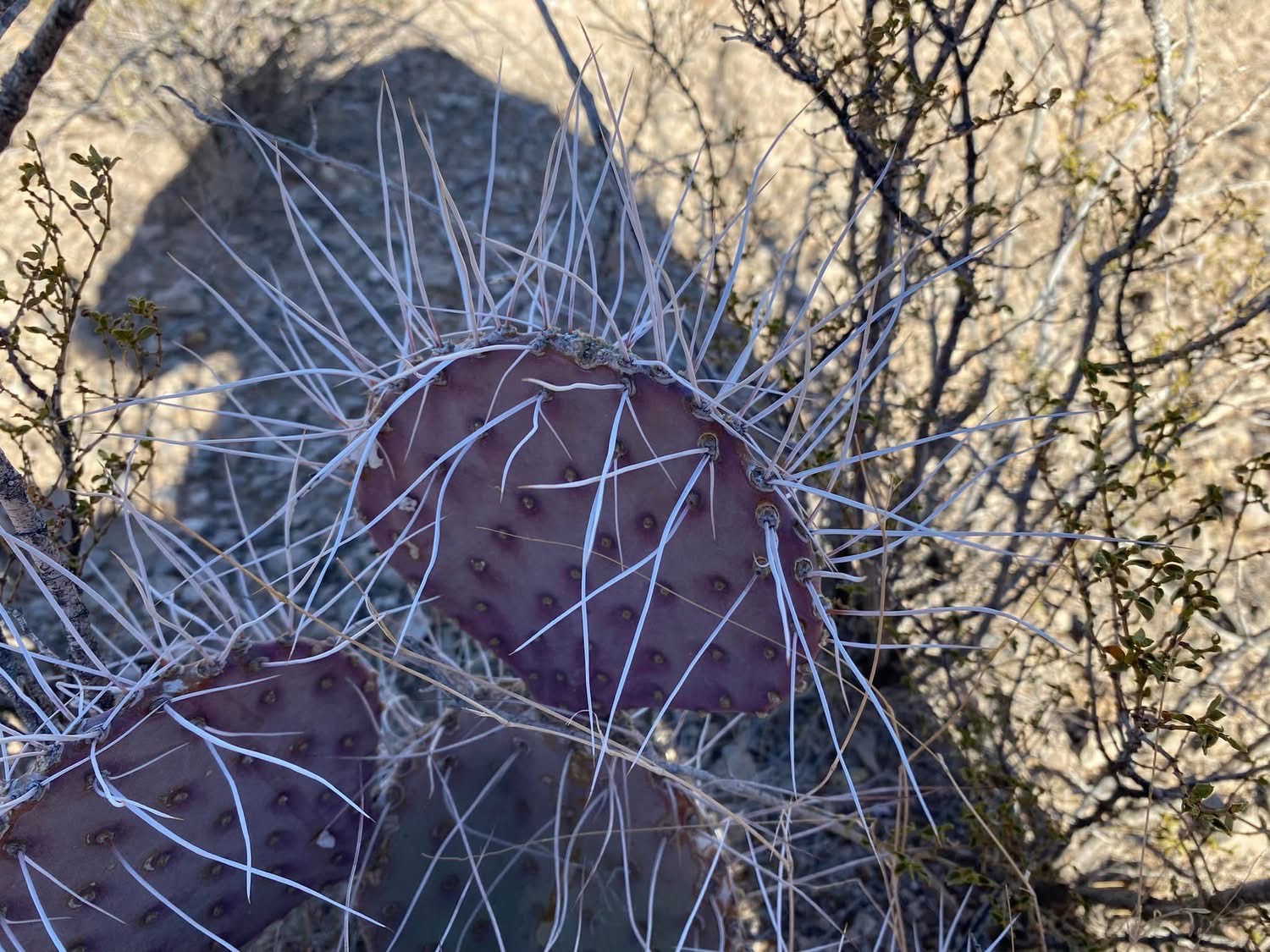
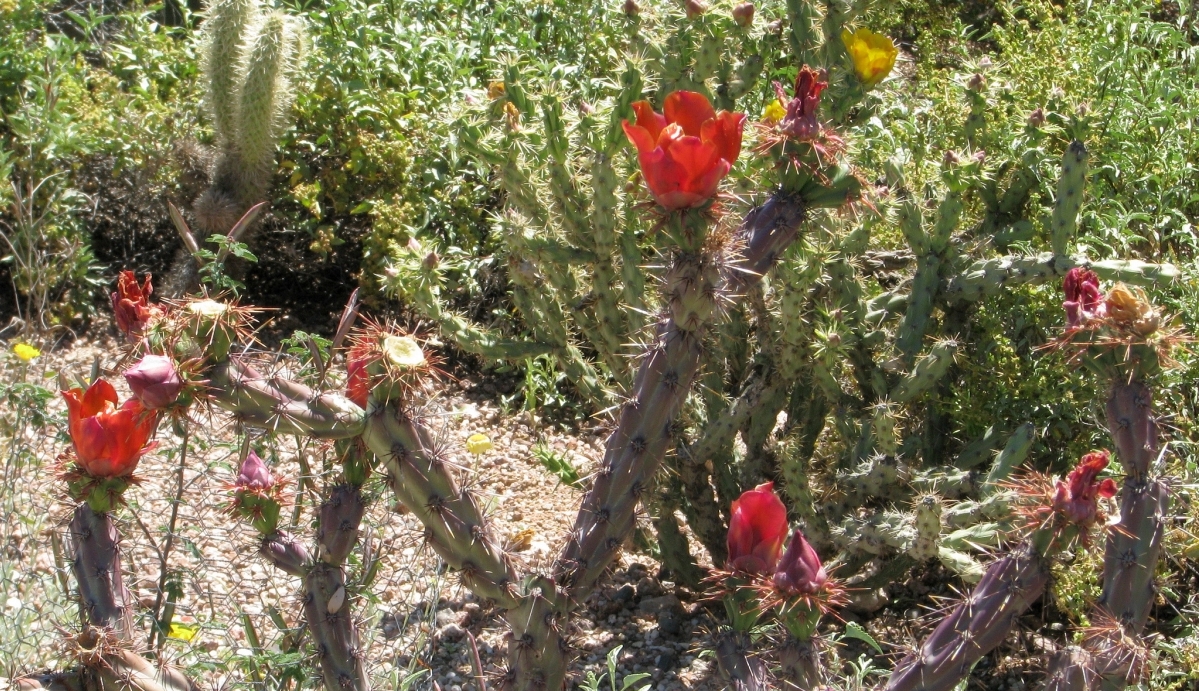
(Photograph = Opuntia orbiculata, New Mexico)
Opuntia Spines
Introduction
In the field, Opuntia spines are the first thing you notice, and the last detail you stop thinking about. On new pads, they start pale and clean; on older pads, they weather to horn, straw, or gray. In hard sun, they cast a fine mesh of shade; in wind, they break the boundary layer. Defense, shade, and a quiet record of growth—built into one structure.
The Details
Areoles, spines, and glochids.
At each areole, the plant builds two tools. Long spines are the obvious ones—stout, straight to slightly curved. Glochids are the small, barbed bristles in the tuft at the center. For identification, both matter because both vary by species, by clone, and by exposure.
How spines vary.
On new joints, spines emerge lighter; on last year’s pads, they dull and pick up dust. Along the margins, spines often run longer and more assertive; on the face, they sit shorter and closer. By number, areoles may be empty, lightly armed, or crowded—patterns that repeat across a plant.
Centrals and radials.
From a few steps back, centrals announce themselves—longer, stiffer, angled outward. Radials lie closer to the pad, tightening the outline. In practice, the split is not perfect, but posture still helps with look-alikes.
Color and texture.
At first, spines can be white, straw, horn, or nearly black; with age, many fade toward tan or gray. Some stay glassy-smooth; others feel faintly rough, catching a stray fiber. In angled light, pale spines brighten a clump; darker spines tighten the silhouette.
Function beyond defense.
After a storm, spines and glochids hold dew, adding small sips to the plant’s budget. During steady sun, dense patches throw dotted shade that cools the skin. Against herbivores, the lesson is obvious.
Reading history on one plant.
On the south side of a clump, spines may be more numerous and shorter; on the north side, fewer and slightly longer. Across a run of pads, wet springs often show as longer, cleaner spines; dry years, as shorter, darker bands.
Field Cues You Can Trust
-
Density: evenly spaced, modest spines read calm; heavy armament reads bristly.
-
Length: long centrals shift the silhouette; short radials polish it.
-
Distribution: margins versus face matters—some plants guard the edges.
-
Glochids: small, pale tufts read tidy; big, shaggy tufts read busy.
-
Consistency: repeating patterns across pads are characters, not noise.
Quick ID Routine
In mixed company, count obvious centrals on six to ten areoles, note whether radials wrap the base like a collar, and check the size and color of the glochid tuft. Then, from a step back, decide whether the overall read is open or bristly. In many pairs, that trio—count, tuft, posture—settles the question.
Related Reading: Thorns, Spines, and Prickles