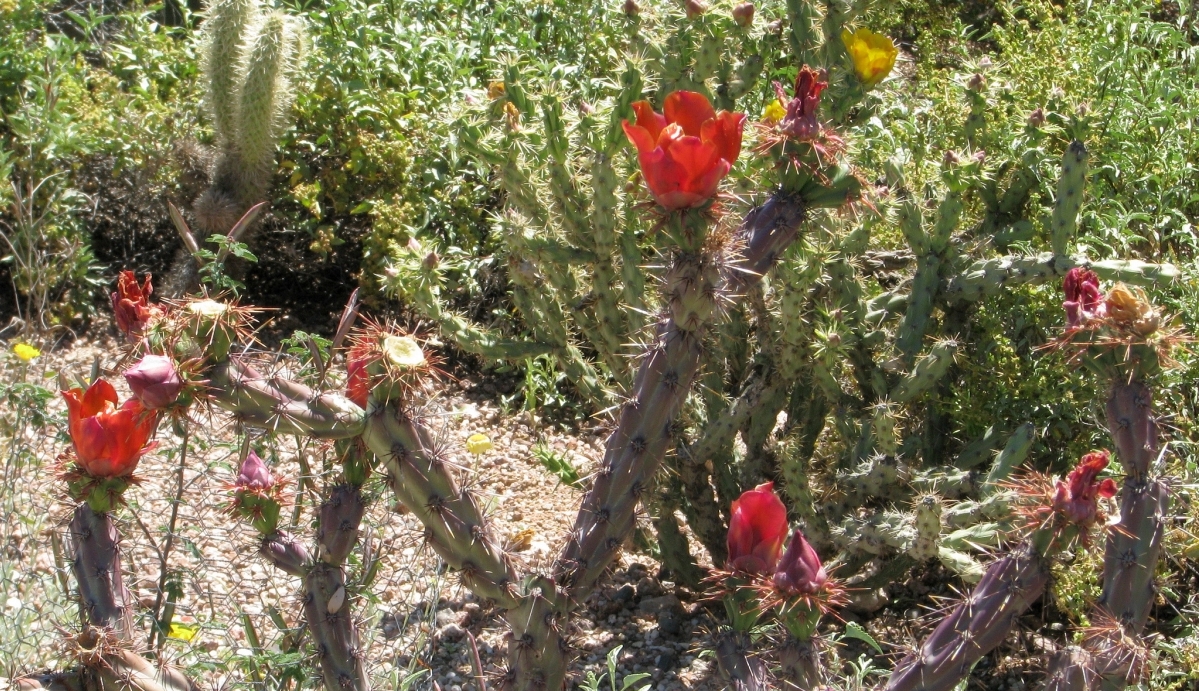
(Photograph = Opuntia engelmannii, Stan Shebs)
Introduction
Opuntia engelmannii—Engelmann’s prickly-pear—is a broad, many-stemmed cactus of the Southwest and northern Mexico. It forms shoulder-high thickets from stacked, oval pads set with tidy rows of areoles that carry glochids and, variably, stout spines. In spring, the outer pads light up with large, satiny flowers; by summer, fleshy purple fruits follow. You see the species on rocky fans, prairie edges, and open woodland, where it stabilizes soil, shelters small animals, and feeds birds and mammals. In Texas and nearby regions, plants often travel under the name O. lindheimeri, reflecting long-standing local usage.
The Details
Form and armament. Pads are broadly obovate to nearly round, dull green rather than strongly glaucous, and thick yet flexible. Areoles are close-set and neat; glochids are abundant. Spination varies—some clones are nearly spineless, others carry several straight to slightly flattened spines per areole, straw to gray with age. Mature clumps reveal a woody interior scaffold—the stacked bases of old pads—that keeps the shrub upright after wind or snow.
Flowers and fruit. Buds develop along pad margins and open from late spring into early summer. Petals are usually yellow, sometimes copper-tinged or blushed orange toward the base. Stamens form a responsive ring around a green stigma. Fruits ripen purple to wine-red, typically with few large spines but plenty of glochids, and hold hard, pale seeds in juicy pulp that many animals—and people—find useful.
Range and habitat. The species ranges from the Sonoran and Chihuahuan deserts into the southern Great Basin and across parts of the southern Plains, with extensions into northern and central Mexico. It favors sun-baked, well-drained ground—bajadas, rocky terraces, sandy washes, and grasslands—but also persists along fencelines and other disturbed sites. Elevation runs from low desert floors to mid-elevation benches where cold air drains off quickly.
Variation and similar plants. Names and boundaries vary among authors. Coastal and south-central Texas plants often pass as O. lindheimeri (treated by some within O. engelmannii), while interior desert forms are commonly more compact and heavily armed. Hybridization with other flat-padded species can blur characters in contact zones, but hybridization is rare. For field ID, rely on the whole suite: robust shrubs; broad, dull-green pads; many glochids; large yellow flowers; and fleshy, purple fruit.
Seasonal rhythm and role. New pads and flower buds push with spring moisture; bloom follows quickly in heat and bright light. Fruits develop through summer as outer pads harden and inner wood supports the canopy. Dense stands provide cover for quail and small mammals, steady nectar and pollen when in bloom, and late-season fruit that helps move seeds downslope and along washes after storms.
Related Reading: Opuntia Web