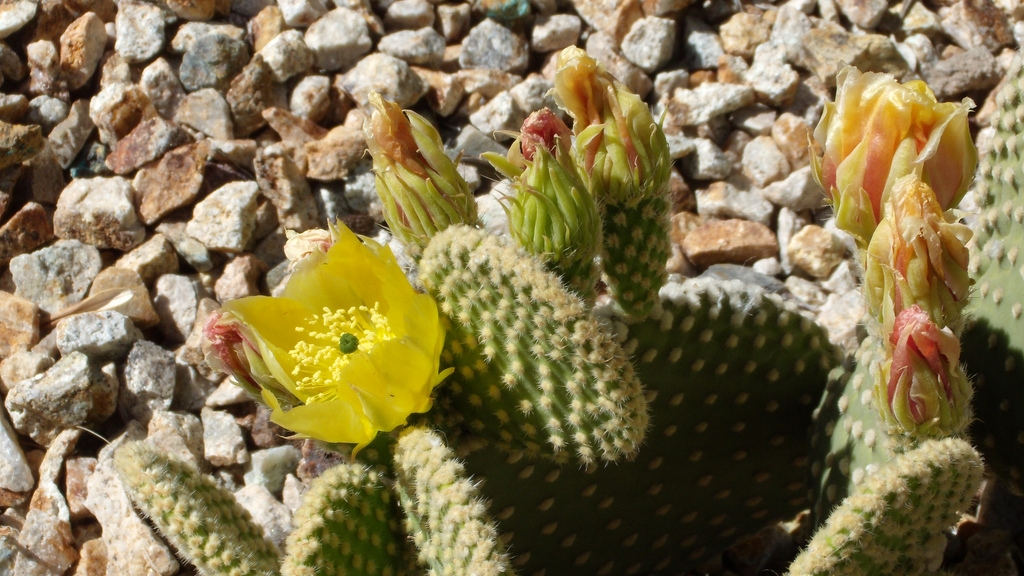
(Photograph = Opuntia gilvescens flowers, Nancy Hussey)
Introduction
Opuntia gilvescens has long been known as a pale-spined, yellow-flowered prickly pear with broad pads and a clean, open stance. The name has a history, and usage varies among authors, but the plant concept—pads that read blue-green to olive, straw-toned spines, and flowers that brighten to gold—remains familiar across much of the Southwest and northern Mexico. Think of it as a practical field handle for a common look: wide joints, neat areoles, and fruit that ripen red to purple.
The Details
Pads and areoles. Pads are obovate to broadly elliptic, medium to large, and usually flat in profile. Areoles sit in even rows, each with a felted center and a small tuft of glochids. New growth shows the areoles slightly raised; older pads weather smoother, and the pattern reads from a few steps back.
Spines. Spines range from none to several per areole. When present, they are typically pale—straw to light horn—often darker at the base with age. Centrals, when developed, are longer and more assertive; radials lie closer to the pad. In angled light, cross-hatching spines give the joint a faint glow.
Flowers and fruit. Flowers open to clear yellow, sometimes taking a salmon or orange wash as they age. Filament and anther tones vary with temperature and time of day. Fruit set is steady after good spring moisture. Ripe fruit are red to purple, with a smooth exterior and shallow areoles near the apex.
Range and Setting
Plants form low to mid-tall clumps on well-drained ground—fans, toeslopes, and open scrub where water moves through quickly after storms. Younger joints often grow under nurse shrubs; older plants emerge into full light and hold their space with broad, slightly angled pads.
Field Cues
-
Silhouette: low, open mounds; broad pads carried at a slight angle rather than strict vertical.
-
Pad surface: blue-green to olive, often with a soft bloom; older joints read smoother and slightly duller.
-
Areoles: evenly spaced; tufts modest, not shaggy.
-
Spination: few to several pale spines; centrals longer, radials close; overall effect tidy, not bristly.
-
Flowers: clean yellow; aging blooms may deepen or show a faint inner flush.
-
Fruit: red to purple at maturity; shape and size fairly consistent within a clump.
Separating Look-Alikes
-
From O. phaeacantha: pads in phaeacantha often run thinner, with longer, duskier centrals and more variable spine counts; flowers can tip deeper in color. Check spine tone and pad carriage—gilvescens usually reads calmer and cleaner.
-
From O. engelmannii sensu lato: taller, denser stands with heavier spination and larger joints hint toward that complex. In gilvescens, spines tend lighter, areoles look neater, and clumps stay more open.
-
From nearly spineless forms: confirm the small glochid tufts and look for a few pale spines on sun-facing pads; complete absence of spines across a plant may indicate a different taxon or a shade-grown clone.
Related Reading: Opuntia Web