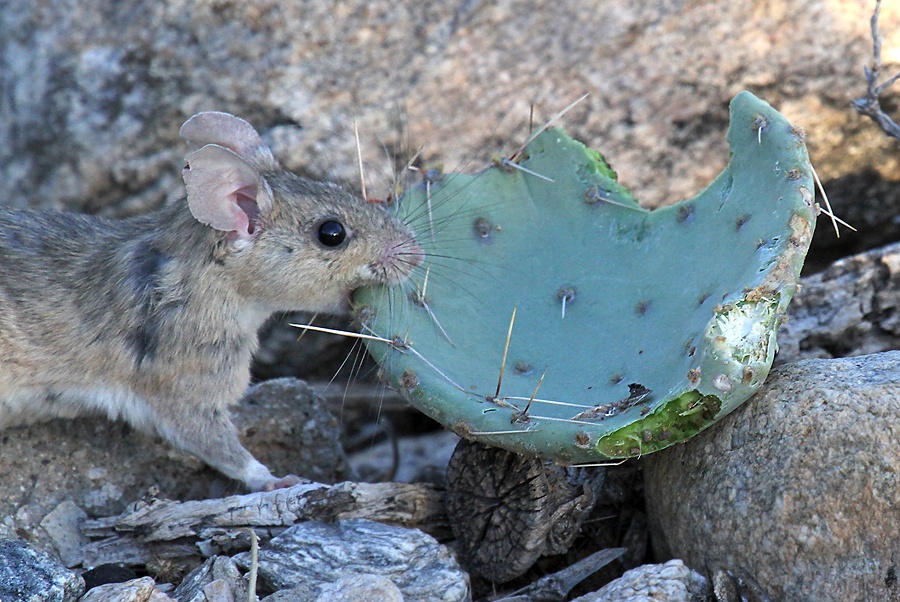
(Photo above: Packrat with Opuntia, searchnetmedia.com)
Introduction
Packrats (woodrats) share desert neighborhoods with agaves, cacti, and yuccas, and the relationships go both ways. These plants provide food, building materials, and spiny protection. In return, packrats move plant parts around, drop seeds, and create small habitat patches where new plants can take hold. In many areas, packrats deliberately nest with these plants—tucking middens beneath cholla clumps, under the leaf “skirts” of large yuccas, or beside boulders where agaves root.
The Details
Packrat homes, called middens, are piles of sticks, leaves, fruits, and odd objects cemented with sticky urine that later dries into a hard crust. Around an active midden, you can often spot a low “fence” of cholla joints, prickly-pear pads, yucca leaves, and agave fibers that discourages foxes, coyotes, and snakes. In Joshua tree and other yucca woodlands, packrats weave dry leaf strips and fallen bracts into the pile; in prickly-pear and cholla flats, they stack spiny joints for wall material; near agaves, they drag wilted leaves and flower-stalk fragments to reinforce entrances.
For food, packrats sample many desert plants, but cacti and yuccas stand out. From prickly pears, they clip pad tips and haul ripe fruits back to cover; from chollas, they gnaw off areoles to reach pulp; from yuccas and agaves, they chew leaf bases, bracts, and fallen stalk sections. Because spines are a problem, they work carefully at edges or strip spines before carrying pieces home.
As they eat, packrats spread seeds. In the shelter of a midden, discarded pulp and dropped seeds collect in damp pockets that stay a bit cooler and shadier than open ground. After summer rains, seedlings often appear along the midden’s drip line or under a ring of stacked cholla. Over time, the pile slows wind at ground level, traps organic matter, and adds nutrients, creating small microsites where prickly pears, chollas, and even yuccas are more likely to take root.
Season matters. During dry spells, succulent tissues—pads and juicy fruits—supply moisture. During cooler months, agave or yucca parts add bulk and insulation. After big flowering years, chewed yucca stalks and short drag trails back to cover are common signs.
In home landscapes, you can reduce unwanted packrat activity by trimming low, dense cover near buildings, elevating firewood, and clearing piles of loose cholla joints. Where you want to watch wildlife instead, plant tough, locally appropriate prickly pears or chollas away from structures, expect some chew marks, and look for small stacks of spiny pieces, polished runways, clipped fruits, and pebble-like droppings—clear signs that a packrat is at work.
Additional Reading: Holocene Packrat Middens
Additional Reading: Pack Rats