Introduction
Pachypodium rutenbergianum (Apocynaceae) is a Madagascan pachycaul tree whose swollen, spiny trunk, terminal leaf clusters, and white, tubular flowers typify drought-adapted architecture in seasonally dry forests. It is frequently confused with P. lamerei and P. geayi, but differs in earlier, freer branching and crown form—differences relevant to systematics and functional morphology. Phenologically, it displays warm-season leaf flush and anthesis, followed by dry-season deciduousness. Flowers mature into paired follicles that dehisce to release plumed seeds adapted to wind dispersal. The sections below summarize diagnosis within the genus, structural and anatomical traits, phenology and reproduction, habitat and geography, and notes on variation and conservation context.
The Details
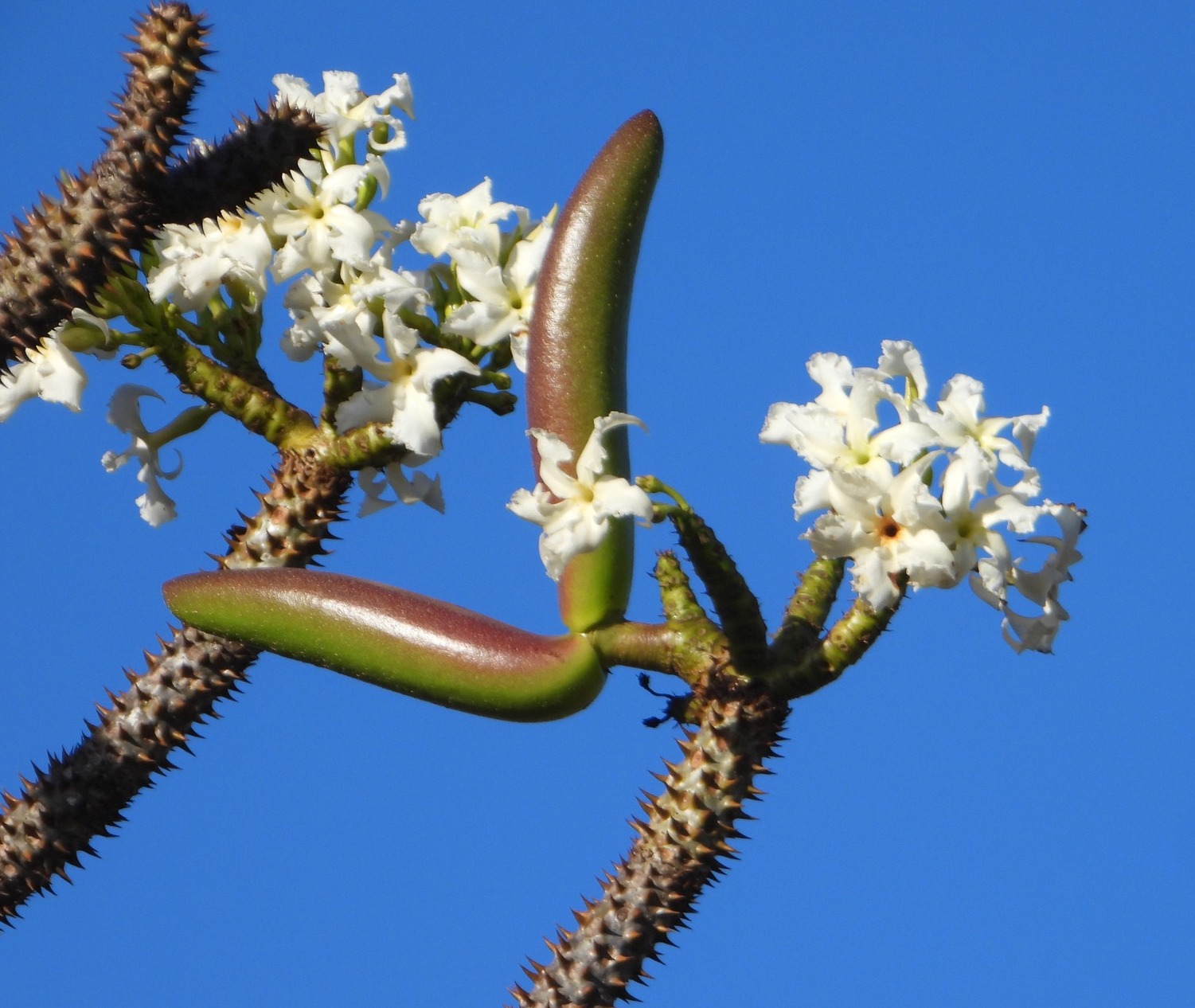
Taxonomy and diagnosis. Within Pachypodium, P. rutenbergianum belongs to the Madagascan arborescent clade. Diagnostic characters include earlier branching (often producing a broad, low crown), clusters of conical spines arising from areoles along trunk and branches, and narrowly elliptic leaves in terminal rosettes. Compared with P. lamerei (typically a taller, single-headed column for many years) and P. geayi (often broader, with a persistent silvery leaf sheen), P. rutenbergianum presents a more domed canopy at maturity.
Gross morphology and anatomy. The massively thickened trunk (pachycauly) functions as a water reservoir and mechanical stabilizer on exposed, rocky sites. Cortex and secondary tissues are water-rich; the pale, often photosynthetically active bark permits limited carbon gain when leaves are absent. Spines—modified stipular or cortical structures at the areole—form defensive arrays that also reduce herbivore climbing. Leaves are glossy, entire, and concentrated at shoot termini, optimizing light capture while minimizing boundary-layer resistance in windy habitats.
Phenology and reproduction. Leaf production and flowering coincide with warm, wet months; leaves are shed during the cool, dry season to lower transpirational demand. Terminal inflorescences bear salverform, white flowers with a pale yellow throat; floral morphology (tube length, pale coloration) is consistent with crepuscular/nocturnal pollination syndromes. Fruits are paired follicles that split longitudinally; each releases numerous compressed seeds bearing a silky coma that enables anemochory. Seedlings establish a pronounced taproot early, reflecting adaptation to episodic moisture in shallow, stony soils.
Habitat and ecology. The species occurs in seasonally dry forests and scrub on rocky or calcareous substrates in western to southern Madagascar. Conditions feature high insolation, large diurnal temperature ranges, and strong wet–dry seasonality. Pachycauly, deciduousness, and armature represent coordinated syndromes for drought buffering, carbon economy, and defense. Latex exudation upon injury provides rapid wound sealing and chemical deterrence typical of Apocynaceae.
Geography and variation. Populations exhibit geographic structure in branching habit, leaf proportions, and spine length/density; several infraspecific names have been applied historically to southern and eastern forms. While these variants intergrade, recognizing local trait combinations aids field identification and clarifies overlap zones with congeners.
Conservation context. As a dry-forest tree specialized for rocky substrates, P. rutenbergianum is sensitive to habitat fragmentation, altered fire regimes, and quarrying. Its arborescent habit and conspicuous morphology make it a target for collection; sustainable, legally sourced seed and protection of dry-forest remnants are consistent with long-term persistence of the species and its associated communities.
All photos were contributed by Amante Darmanin.
Additional Reading: Pachypodium lealii