
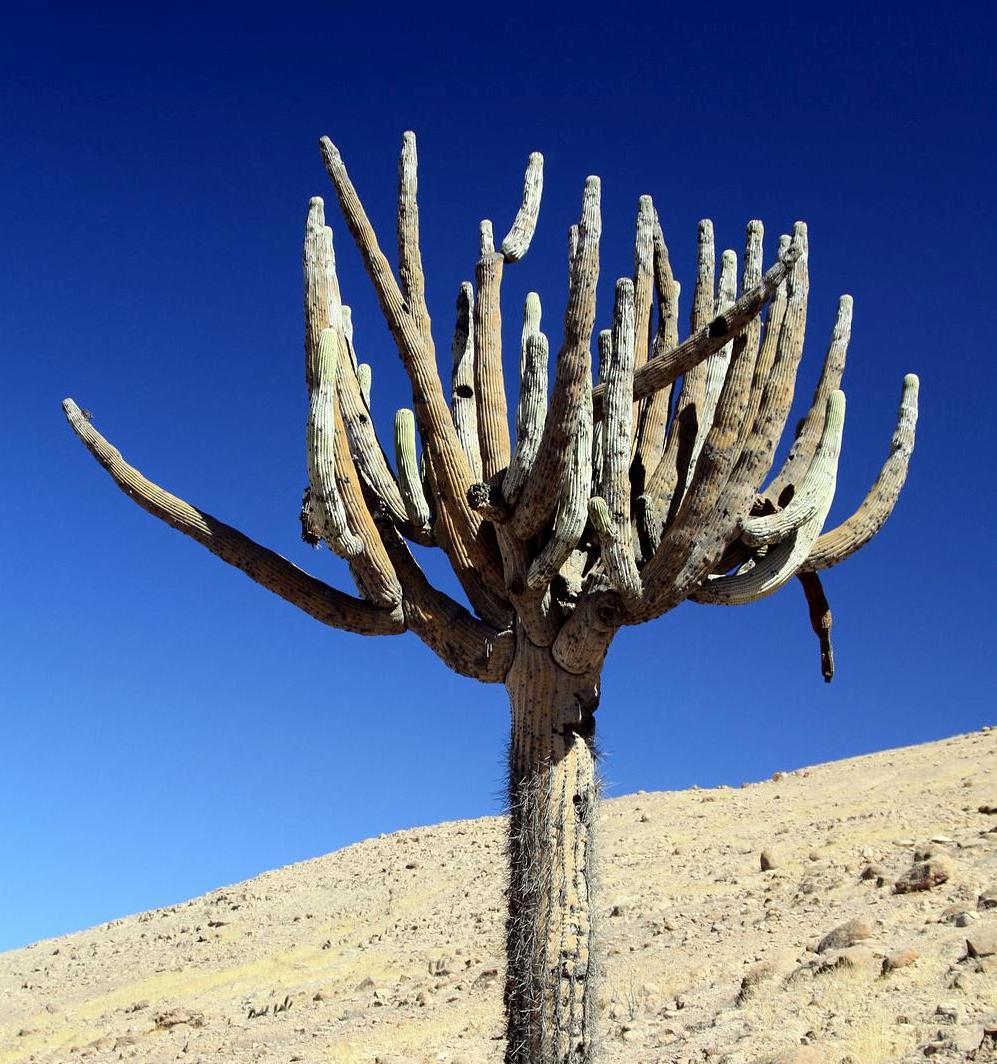
(Photograph = Neoraimondia gigantea, Craig Howe)
Introduction
Peru holds an extraordinary spread of landscapes—tropical forest, fog-fed coast, river canyons, and the high, cold puna. Within that range, cacti occupy everything from misty sea-cliffs to sun-blasted interior valleys. From sea level, you can drive into the foothills in a single day, and the cast of species changes with every rise in altitude and every shift in rock and soil. As a result, the country’s cactus flora reads like a living checklist: small, tight rosettes; ribbed barrels; woolly columns; and tree-sized giants that anchor entire hillsides.
The Details
Across Peru, growth form is a quick guide. At lower elevations and along the coast, tall, woody columnars dominate dry slopes and quebradas; higher inland, smaller globose and short-columnar plants pick through thin, mineral soils. In many places, fog and cold air pool at night, then burn off by mid-morning—a daily swing that suits stems built to store water and shed heat.
Melocactus. In this group, plants begin as tidy, globose bodies and later switch on a short cylinder at the top—the cephalium—where flowers and fruits appear. Before the cephalium forms, plants are all promise; after it forms, they bloom steadily in the warm season. In Peru, several species occupy lower to middle elevations, often on stony, well-drained slopes.
Corryocactus. Named for the region around Chachapoyas, Corryocactus chachapoyensis grows as a branched shrub with stiff, upright stems. In the field, yellow flowers help separate it from neighboring columnars. On rocky brows and ledges, it forms thickets that catch morning light and wind.
Neoraimondia. Near the coast at lower altitudes, Neoraimondia gigantea sends up a half-dozen parallel shoots from a stout base. Mature plants read like small trees, woody and pale green, with delicate pink flowers that ring the stem tips. In harsh light, the ribs throw sharp shadows that make the plants easy to pick out at a distance.
Espostoa. On younger growth, many Espostoa wear a soft, white fleece—fine hairs that blur the spines and give seedlings a cottony look. Espostoa lanata shows this character clearly; from a distance, the plants glow, and up close, the wool packs densely between the areoles. On cliffs and steep fans, that insulation breaks wind and moderates sun.
Echinopsis (Trichocereus) and allies. In interior valleys and on drier ridges, large, ribbed columns carry broad, showy flowers that open in the cool hours. Alongside them, small, globose species tuck into pockets where frost drains off quickly and where a few centimeters of grit collect after seasonal storms.
In the field, a few habits help. In early morning, scan ridgelines for silhouettes; by midday, use shadows under ribs to separate species. On safe ground, step off the track only where the crust is firm—thin soils and rock varnish scar easily. With a notebook, and with time to watch the light, Peru’s cactus zones sort themselves by form, fleece, and flower—coast to cordillera, valley by valley.
Additional Reading: Tephrocactus verschaffeltii in Peru




Hi: Hope to visit Peru soon….anyone know of good viewing areas ?
Thanks, Coleman