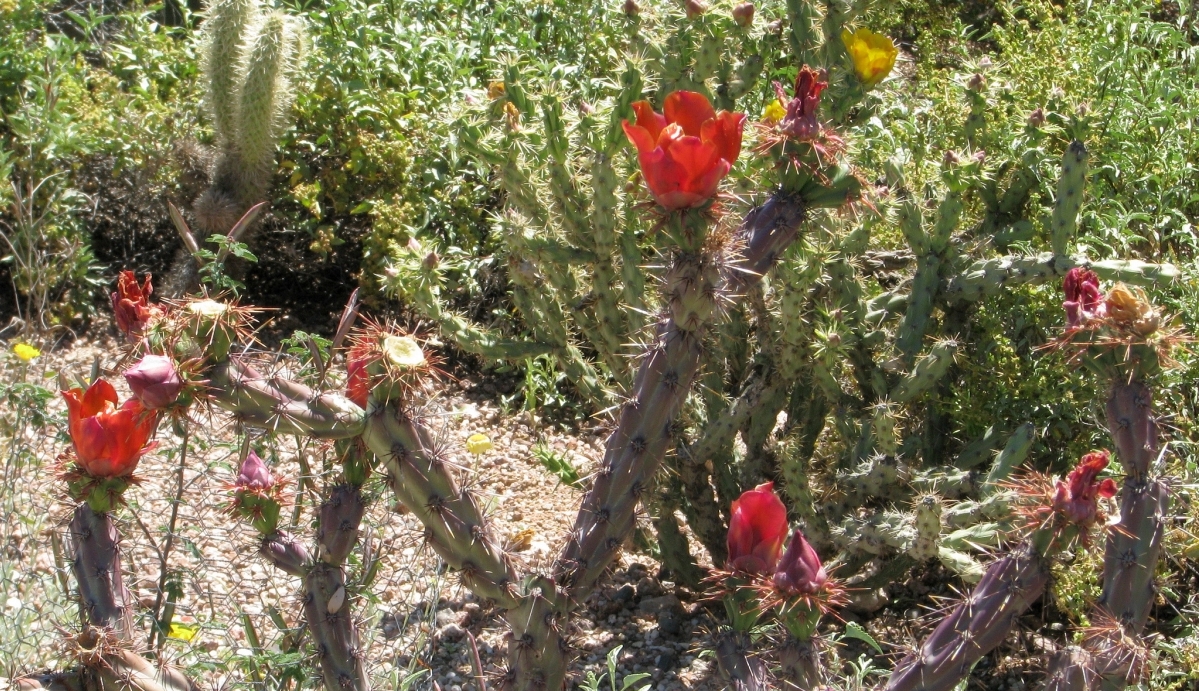
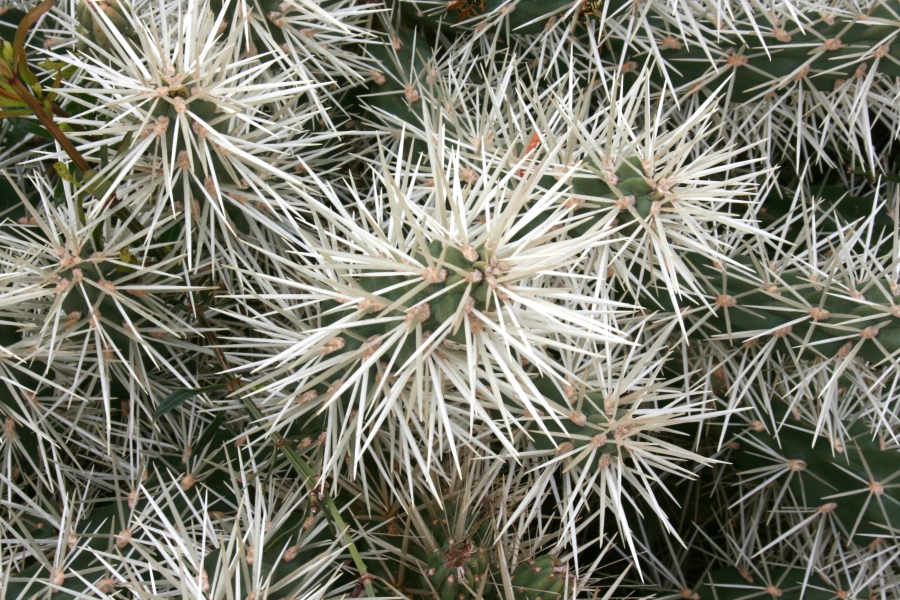
(Photograph = Cylindropuntia abyssi, Nancy Hussey)
Introduction
In canyon country, Cylindropuntia abyssi reads clean and deliberate—upright to gently arching stems, tightly spaced nodes, and spines wrapped in thin, translucent sheaths. From a distance, the plant resolves into narrow columns that step down talus and benches. Up close, the details settle the name: even areole spacing, sheathed spines that glow in angled light, and fruit that persist long after bloom.
The Details
Name and place.
In keeping with its epithet, abyssi favors rims, ledges, and broken benches where water moves away quickly. As a field concept, think narrow joints, modest branching, and pale armament that reads straw to horn through the sheath.
Architecture.
From a short, often concealed base, one to several leaders rise and branch sparingly above knee height. Segment length is moderate; thickness stays on the slender side, so the outline remains airy rather than bulky. Old wood runs gray and ridged; new joints are firm and evenly tuberculate.
Segments and areoles.
Segments are cylindrical, with shallow constrictions at the nodes. Areoles are small to medium, oval, and felted, set in consistent rows that hold their rhythm across the joint. Glochids occupy the central tuft and darken with age. In oblique light, the areole grid reads as quiet texture rather than noise.
Spines and sheaths.
Each areole carries few to several spines. Centrals, when present, are slightly heavier and angled outward; radials lie closer to the skin, tightening the outline. Sheaths are thin and glassy when fresh, turning opaque and straw-colored with time; some weather to gray, and a few slough in strips on older joints. From a few steps back, fresh bands glow, while older bands mute and merge into the stem tone.
Flowers and fruit.
In late spring into early summer, buds push near the terminal nodes. Flowers open modestly—yellow-green to cream, sometimes with a soft blush depending on clone and temperature. Tubes rise just clear of the spines. Fruit follow as tuberculate cylinders with shallow areoles and usually scant armament. Ripe fruit persist well into the dry season and hang near branch tips like small lanterns.
Aging and weather.
With time, lower segments cork lightly, and the plant carries a readable record of seasons—clean, pale sheath zones after good growth, duller bands after stress. On wind-exposed faces, a faint “lean” in outer joints often mirrors prevailing gusts; along sheltered walls, joints stand truer and longer.
Range and Setting
On rocky benches, toeslopes, and breaks above inner canyons, abyssi takes the places that shed water fast. In morning shade, stems read muted gray-green; by midday, the sheaths lighten and the whole shrub brightens; by late light, long, fine shadows sharpen the silhouette. Among nurse shrubs, young plants lean against stone; in open ground, older plants stand free and carry their own shade. Across substrates—limestone, basalt, or sandstone—the same pattern repeats: narrow columns, tidy spacing, and pale armament.
Field Cues
-
Silhouette: narrow, upright to gently arching columns; branching controlled rather than broomy.
-
Segments: moderate length, slender build, shallow node constrictions, and uniform areole spacing.
-
Spination: few to several per areole; centrals slightly longer; radials close; sheaths translucent when fresh, straw to gray with age.
-
Fruit: small to medium, tuberculate, typically persistent, and held near outer, sunlit tips.
-
Overall read: tidy, linear, and lightly armed compared with bushier, heavier chollas nearby.
Separating Look-Alikes
-
vs. C. spinosior — bushier habit, denser armament, and deeper magenta-leaning flowers flag spinosior; abyssi holds narrower joints, cleaner spacing, and a calmer color range.
-
vs. C. imbricata — thicker “cane” segments, heavy branching, and large magenta flowers mark imbricata at a glance; abyssi is slimmer, paler, and less massive.
-
vs. C. whipplei sensu lato — longer, stouter joints and more austere, even armament hint toward whipplei; in abyssi, node spacing is tighter, and fresh sheaths read lighter.
-
vs. C. echinocarpa — “silver cholla” throws a dense, silvery halo of short spines and shorter segments; abyssi presents fewer, longer lines and a less bristly surface.
-
vs. C. acanthocarpa — more branched, with thicker joints and heavier spination; abyssi keeps its measured, columnar rhythm and subdued sheath palette.
Related Reading: Cylindropuntia chuckwallensis