Introduction
Aloe bowiea (Coega dwarf aloe; “Bowie’s aloe”) is a minute, mat-forming grass aloe endemic to South Africa’s Eastern Cape (around Gqeberha/Kariega). It occupies open patches within thicket–karroid mosaics near sea level and is nationally assessed as Endangered because of habitat loss and illegal collecting.
The Details
Taxonomy and phylogeny. First described as Bowiea africana Haw. (1824), the species was transferred to Aloe as A. bowiea by J.A. & J.H. Schultes (1829); Chamaealoe africana is a later synonym. Current consensus places it within Aloe sensu stricto (subsection Bowieae), while allied alooids have been segregated to Aloidendron, Aloiampelos, Aristaloe, Gonialoe, and Kumara.
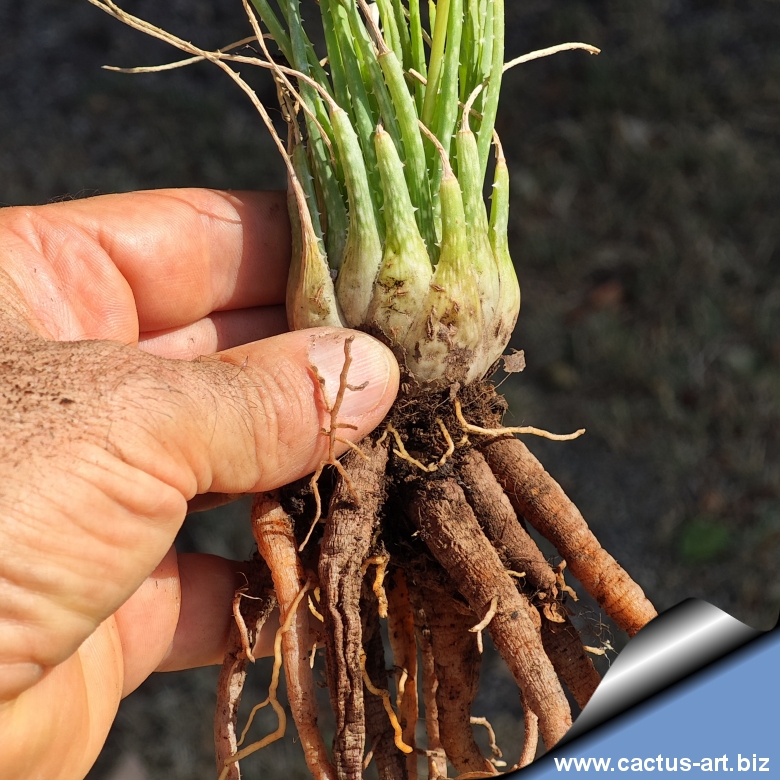
Identification. Plants are stemless, typically under 15 cm tall, forming tight tufts or mats. Leaves are numerous, linear, pale green with fine longitudinal lines and minute marginal teeth; inflorescences are simple (to a few decimeters) with small greenish-white, tubular flowers. Thick, spindle-shaped roots and the tufted habit are characteristic.
Distribution and ecology. The range is highly localized—principally between Uitenhage and Coega Kop, with an outlying site near Kirkwood—on rocky outcrops and level to southwest-facing slopes in Motherwell Karroid, Sundays Valley, and Baviaans Valley Thicket. A summer-rainfall climate, periodic fire, and drought shape its ecology; fire responses include resprouting from protected roots and leaves that resist ignition.
Conservation. Status: Endangered (assessment 4 March 2019). Estimated extent of occurrence 23–548 km²; area of occupancy 20–24 km²; four to five locations. Major threats are urban/industrial expansion (Uitenhage–Despatch–Coega), quarrying at Coega Kop, overgrazing, dumping, and illegal succulent collecting; population trend decreasing.
Cultivation. Grow warm and frost-free (avoid ≤ 0 °C), in bright light with some protection from intense midsummer sun. Use a sharply drained mix (e.g., potting soil with coarse sand/perlite/pumice about 1:1); water thoroughly in growth, then allow to dry; reduce in winter. Propagate by basal offsets or from seed in spring–summer.
Notes and potential confusion. Do not confuse Aloe bowiea with Bowiea volubilis (a bulbous asparagaceous vine) or with other “grass aloes.” The combination of extreme small size, mat-forming habit, pale lined leaves, and very restricted Eastern Cape range is distinctive. Synonyms such as Bowiea africana and Chamaealoe africana appear in historical literature.
Aloe liliputana, a new grass aloe from Pondoland