Introduction
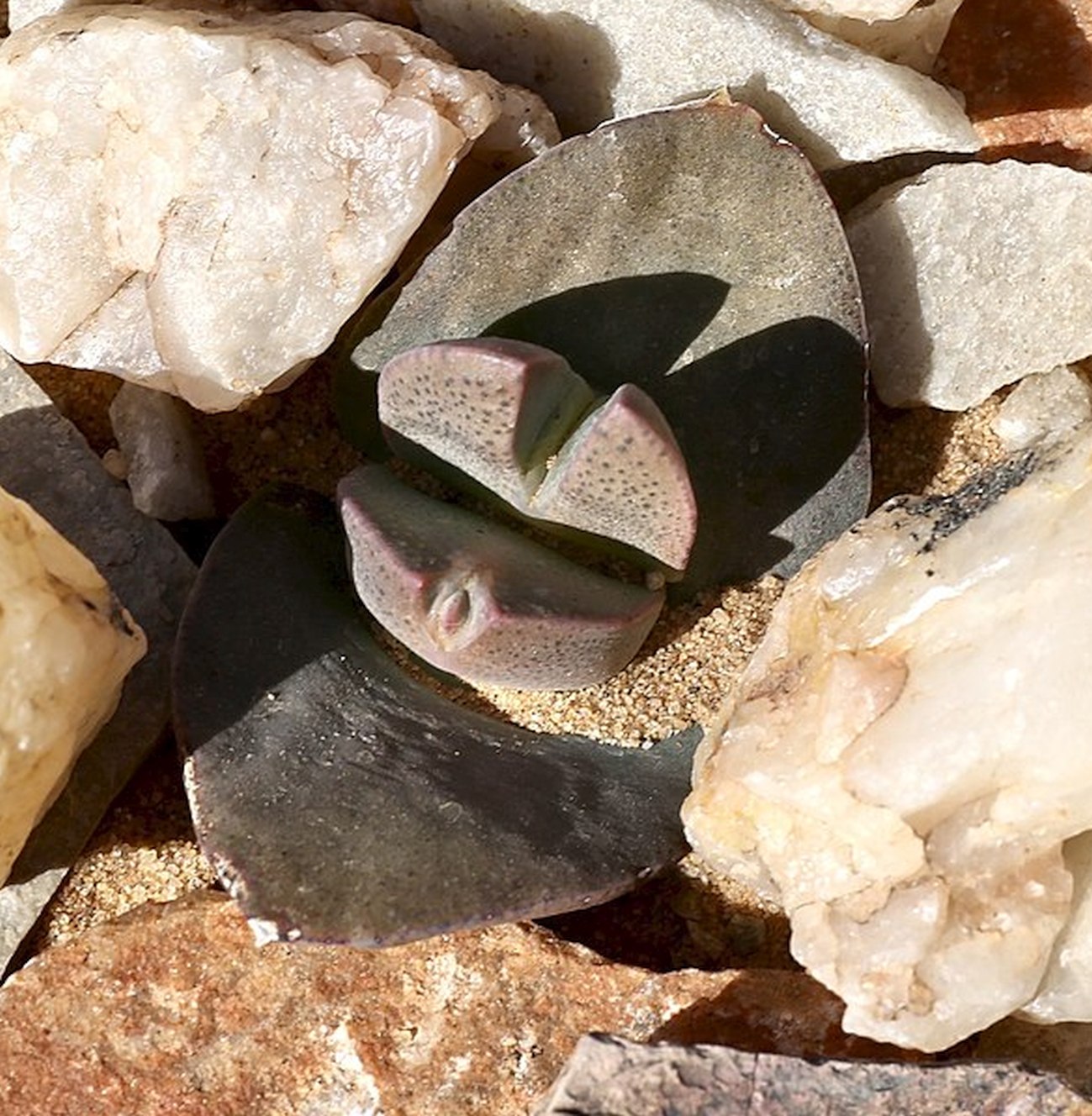
Cheiridopsis is a genus of compact, clump-forming succulents in the Aizoaceae native to the winter-rainfall deserts of the Richtersveld and Namaqualand of South Africa and southern Namibia. Succulent Guide Plants characteristically produce opposite pairs of thick, often glaucous leaves; the previous pair dries into a protective sheath, a trait reflected in the name from Greek for “sleeve.” World of Succulents Flowers are daisy-like, in white, yellow, orange, or magenta, opening in bright weather and followed by hygrochastic capsules that release seed when wetted. Species occupy quartz plains, granite or sandstone outcrops, and sandy washes, forming micro-endemics adapted to precise soils, fog regimes, and seasonal moisture.
The Details
Cheiridopsis comprises roughly three dozen to one hundred named species, most confined to the winter-rainfall belt from southern Namibia through South Africa’s Namaqualand and into the northern Western Cape, where quartz flats, granite pavements, and sandy washes create a mosaic of niches. WFO Plant List+1 Across the genus, plants bear opposite leaf pairs that emerge from within a papery sheath formed by the previous season’s leaves—hence the name, from the Greek for “sleeve.” Flowers are usually daisy-like and brightly colored, and fruiting capsules open when wet to disperse seeds across brief desert pulses.
Within this range, species exhibit strikingly different forms. The widely encountered C. denticulata bears elongate, bluish leaves; some populations show the namesake small “teeth” along a keel near the tip, and plants produce showy, variable-colored blooms (whites, yellows, oranges, sometimes magenta). The Ruth Bancroft Garden & Nursery+1 C. pillansii forms tight, cushiony clumps with short, thick leaf pairs and occurs in Little Namaqualand near Steinkopf. Llifle C. peculiaris, as its name suggests, has a peculiar, architectural leaf geometry and is a narrow endemic within the south-eastern Richtersveld. Llifle C. meyeri inhabits Namaqualand and exemplifies compact, clump-forming growth with glaucous, opposite leaves. POWO Other representatives include C. acuminata, with sharply pointed leaves; C. carinata, named for its keeled foliage; and C. alba-oculata, described more recently from the Garies region, which underscores how localized survey work continues to reveal range-restricted taxa. WFO Plant List+2WFO Plant List+2
Taxonomists recognize subgenera that reflect leaf symmetry and capsule characters (e.g., subg. Aequifoliae, Odontophoroides, and Cheiridopsis), but boundaries can blur where populations are isolated on different geological substrates or fog regimes. World Flora Online Many species are micro-endemics whose distributions may be measured in a few hill slopes or a single quartz plain. Field botanists often separate taxa by combinations of leaf length and cross-section, keel development, surface bloom (the whitish pruina), denticulation, and flowering season, together with subtle differences in seed capsules.
Ecologically, Cheiridopsis occupy open, sun-washed habitats where reflectance from quartz gravel and cool oceanic air masses moderate extremes. Seasonality is pronounced: plants lean on cool-season moisture from frontal systems, retreating to tight sheaths and reduced metabolism during the hottest months. Flower color ranges from pure white through golden and tangerine tones to purples in some lineages, attracting diurnal pollinators; hygrochastic capsules safeguard seed until episodic rains arrive. Succulent Guide In situ, populations can be dense on suitable benches yet absent a few kilometers away where substrate or rainfall pattern shifts. Consequently, conservation assessments hinge on fine-scale habitat mapping; restricted endemics like C. peculiaris and localized forms allied to C. pillansii may be vulnerable to surface disturbance, mining, or prolonged drought.
Cheiridopsis also serve as a model for morpho-ecological variation within the Aizoaceae: repeated evolution of protective sheathing, leaf pruinosity that increases reflectance, and compact architectures that minimize boundary-layer water loss. The genus presents attractive problems in species delimitation, where historical names reflect single localities and modern surveys reveal clines and mosaics. Ongoing work combining field observation, herbarium study, and high-resolution mapping continues to clarify relationships among named taxa and to document new, narrowly distributed species across the Richtersveld–Namaqualand landscape and modern genetics.
Additional Reading: Cheiridopsis alba-oculata


