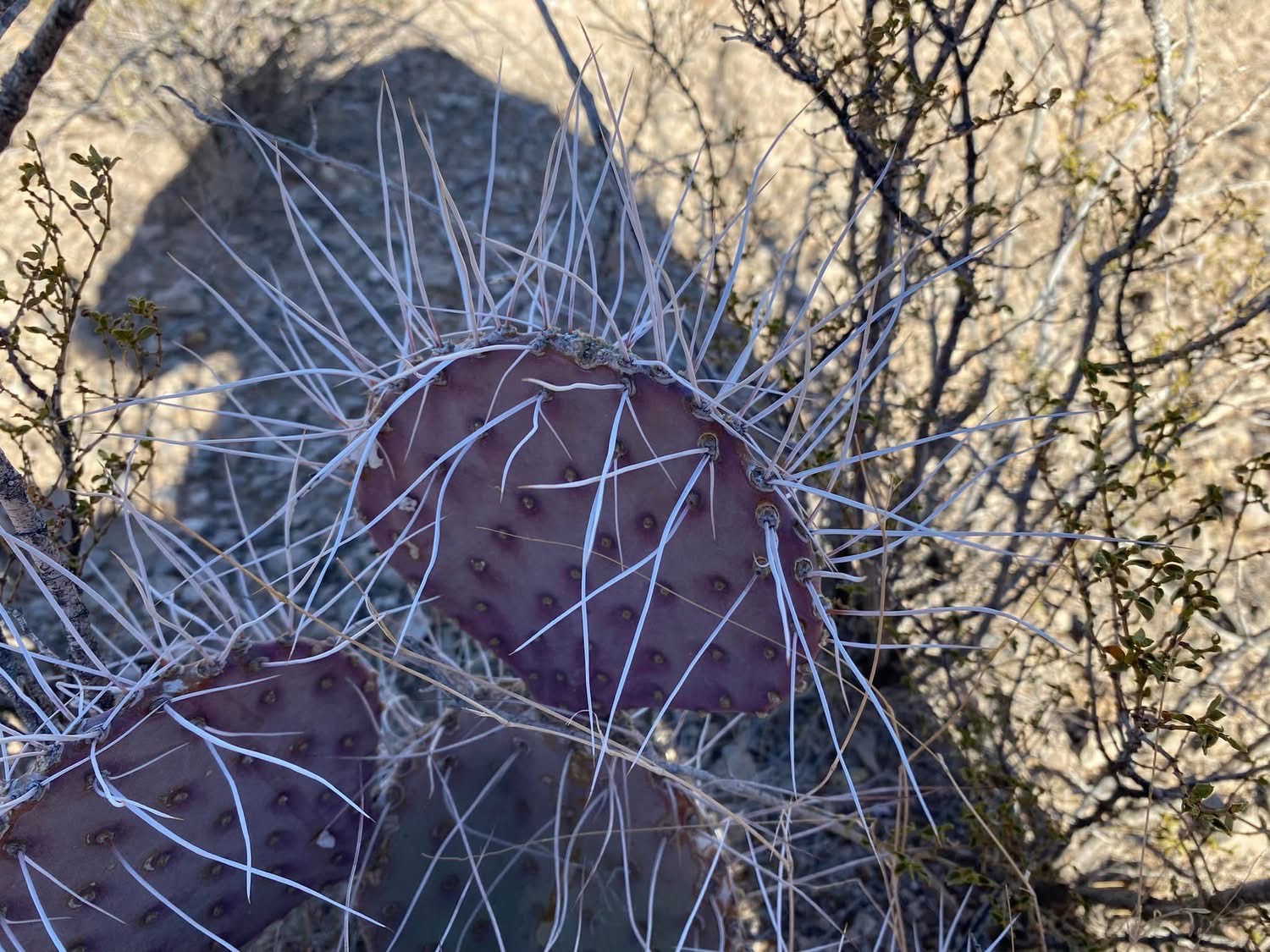
(Photograph = Opuntia basilaris)
Introduction
Opuntia species are common across much of the American West but are less frequent in the very driest deserts. Opuntia basilaris is one of the few that is easy to find at low elevations in the Mojave Desert, where annual rainfall may average only 6–8 inches.
The Details
O. basilaris has the classic “beavertail” look. Cladodes form dense clumps 5–20 inches tall and typically about 1 foot across (occasionally to 5 feet). Pads are blue-green and roundish to wedge-shaped, usually 5–8 inches long (sometimes to 10). They are often fan-shaped, but may be oval, obovate, or elongate-obovate. In the main variety (basilaris), pads arise from a single point and form an irregular rosette. Areoles are slightly sunken.
There are at least five described varieties:
-
basilaris
-
brachyclada
-
longiareolata
-
ramosa
-
treleasei
All varieties are spineless except var. treleasei. O. basilaris var. basilaris is by far the most commonly encountered variety. O. basilaris varieties are generally diploid, but O. basilaris var. treleasei is triploid and may represent a separate taxon.
Additional Reading: Bakersfield Cactus