Far off South America, the Galápagos received chance arrivals—iguanas, birds, and Opuntia among them—that diverged in isolation. Salt spray, thin soils, intense sun, and browsing by large reptiles pushed prickly pears into distinctive tree and shrub forms that anchor dry-zone ecology.
The Details
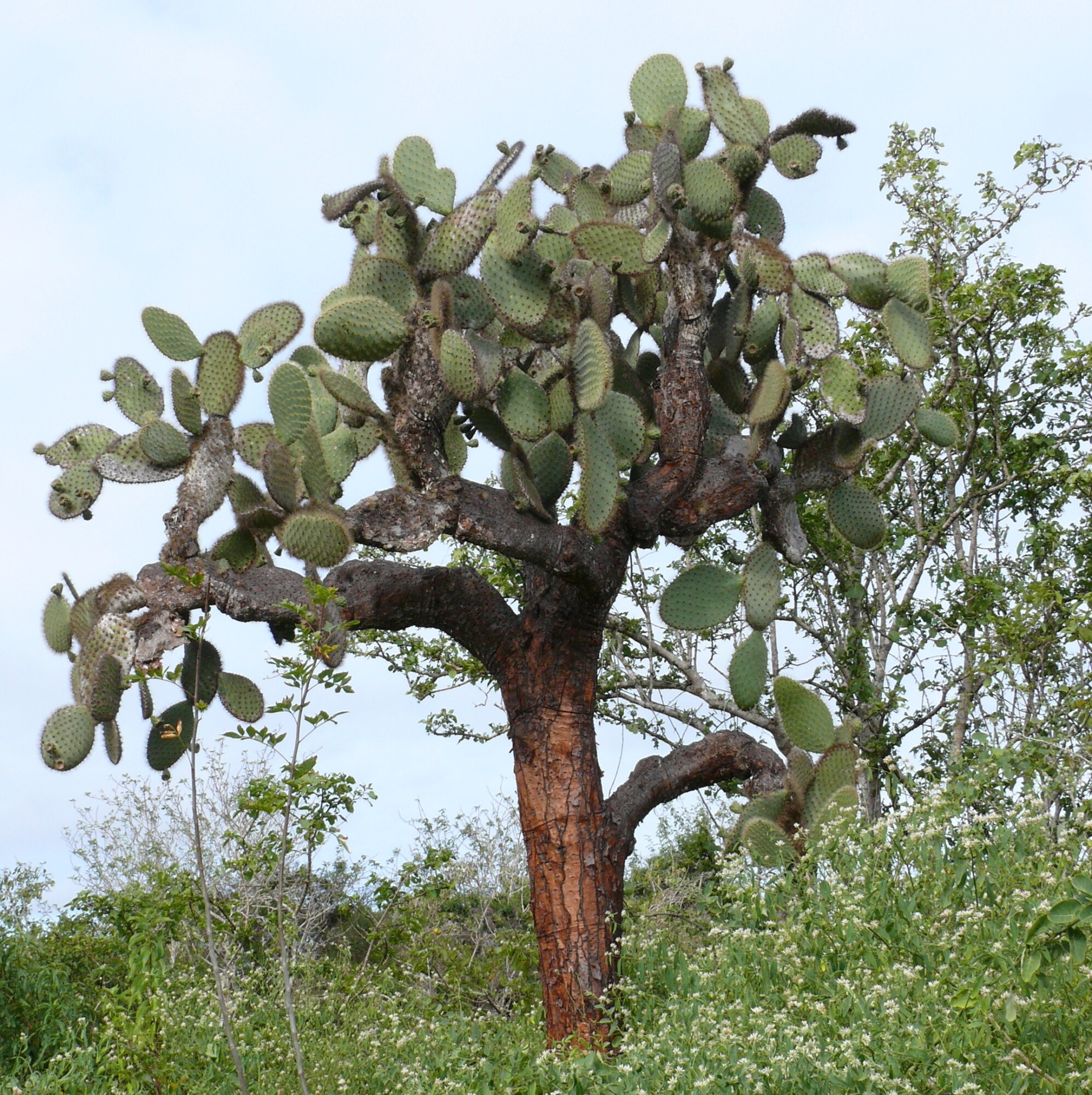
Depending on how varieties are treated, the archipelago hosts roughly four to six species with about a dozen named varieties, many tied to single islands. Growth ranges from low, sprawling shrubs to tall, umbrella-crowned trees on older lava. On islands with heavy browsing by tortoises and land iguanas, plants tend to be taller, with bare trunks and pads held above bite height; where browsers are scarce, plants are shorter and more freely branching.
Ecologically, Opuntia stores water, casts scarce shade, and feeds animals through much of the year—first with nectar and pollen, then with dense fruits. In drought, dropped pads can root and help stabilize loose substrates.
Who eats Opuntia
Giant tortoises and land iguanas browse pads and fruits. Cactus finches visit flowers for nectar and pollen, transfer pollen between plants, and later take seeds; carpenter bees and other insects contribute. Doves and mockingbirds move pulp and seeds and clean up fallen fruit. In lean periods, finches sometimes clip stigmas to access pollen, which can reduce seed set even as they also pollinate.
Seasonality and dispersal
At the start of the warm, wet season, plants push new pads and then flowers. Birds carry most pollen between scattered plants. As fruits ripen into the cool, foggy garúa season, birds and reptiles disperse seeds across lava cracks and sandy pockets.
Conservation notes
Introduced herbivores, past clearing, and weeds have, at times, pushed local Opuntia down. Where goats and other browsers were removed, recovery followed, though slowly on some islands. Because small populations can crash after a bad sequence of drought and heavy browsing, ongoing quarantine, monitoring, and habitat protection remain essential.
(Images: Conolophus subcristatus, Gregory Smith · Giant Tortoise with Opuntia, fineartamerica.com · Cactus finch eating pollen, wildlifetravel.com · Opuntia megasperma, Herpetologist · Opuntia with immature fruit, Andy Jones · Opuntia flower, Sally Taylor · O. echios var. barringtonensis, Jason Hollinger · O. echios var. zacana, Haplochromis · O. megasperma var. megasperma, wildlifetravel.com)
Who Eats Opuntia
Opuntia megasperma, Herpetologist
Opuntia species with immature fruit, Andy Jones
Opuntia Flower, Sally Taylor
Opuntia echios var. barringtonensis, Jason Hollinger
Opuntia echios var zacana, Haplochromis
Opuntia megasperma var megasperma, wildlifetravel.com
Thanks Joe, Love the plants of the Galapagos. I would LOVE to collect them all, but not sure that’d ever be possible. Certainly would never live long enough to see them ever reach the Mammoth sizes they do on the islands.
If I ever get there, I’d be happy to share some of the photos ;-)
Hi Paul,
Thanks for visiting Oblog. I’m with you; I would like to grow the Galapagose Opuntias though I might never see them grow tall.
Joe
Hi, joe.
Do you remember me.
This is the first comment to the renewal blog.
I have Opuntia galapageia from seeding the seed of The Mesa Garden.
I wonder which of the four species is mine?
How do you think?
3 Comments
Add Yours →Thanks Joe, Love the plants of the Galapagos. I would LOVE to collect them all, but not sure that’d ever be possible. Certainly would never live long enough to see them ever reach the Mammoth sizes they do on the islands.
If I ever get there, I’d be happy to share some of the photos ;-)
Hi Paul,
Thanks for visiting Oblog. I’m with you; I would like to grow the Galapagose Opuntias though I might never see them grow tall.
Joe
Hi, joe.
Do you remember me.
This is the first comment to the renewal blog.
I have Opuntia galapageia from seeding the seed of The Mesa Garden.
I wonder which of the four species is mine?
How do you think?