Introduction
Acanthosicyos is a small, distinctive, xerophytic genus in the cucumber family (Cucurbitaceae) adapted to some of the driest landscapes in southern Africa. Its best-known member, the nara melon (Acanthosicyos horrida), forms dense, leafless, thorny hummocks along coastal desert dunes, where fog and hidden groundwater are more reliable than rain. A second species, often called the gemsbok or Kalahari cucumber (Acanthosicyos naudinianus), is a tuber-forming vine of inland sands. Together they showcase a striking range of desert strategies—spine-armored branches, reduced leaves, deep or massive storage organs, and fruits packed with energy-rich seeds—that anchor food webs, stabilize dunes, and sustain local communities.
The Details
Among cucurbits, Acanthosicyos stands out for its architectural extremes. A. horrida trades typical leaves for photosynthetic, intricately branched, green stems bristling with stout spines. This reduction of leaf surface limits water loss, while the spiny lattice traps wind-blown sand and creates self-built embankments that shelter young shoots and small animals. The plant grows as sprawling, dome-like mounds on shifting dunes and river terraces in the Namib, especially where shallow groundwater lenses or periodic flood recharge persist beneath the sand. Morning fogs drifting inland from the Atlantic add a dependable pulse of moisture, wetting stems and the sand surface; the plant’s geometry slows air flow enough that condensed droplets can trickle to the root zone.
The flowers are small and pale yellow, borne on separate male and female plants (the genus is typically dioecious). Male plants produce clusters of flowers that release pollen over an extended period, while females carry solitary blooms that mature into heavy, melon-like fruits guarded by short spines. These fruits, often partly buried by moving sand, develop a thick rind and a moist, aromatic pulp enclosing numerous flat, nutrient-dense seeds. Jackals, porcupines, ostriches, and other desert dwellers feed on the pulp and seeds, dragging or rolling fruits, gnawing openings through the rind, and dispersing seeds across the dune fields. People do the same: for coastal communities, nara fruits and especially their oil-rich seeds are seasonal staples used fresh, dried, roasted, or pressed for cooking oil.
Below ground, A. horrida invests in a robust root system capable of probing downward and laterally to intercept moisture pockets. The plant tolerates sand burial and abrasion; new shoots readily re-emerge after dunes shift. Seedling establishment is episodic—often tied to rare alignments of temperature, fog humidity, and shallow moisture—but once established, hummocks can persist for decades, knitting dunes into semi-stable landforms and providing windbreaks and shade that moderate surface temperatures.
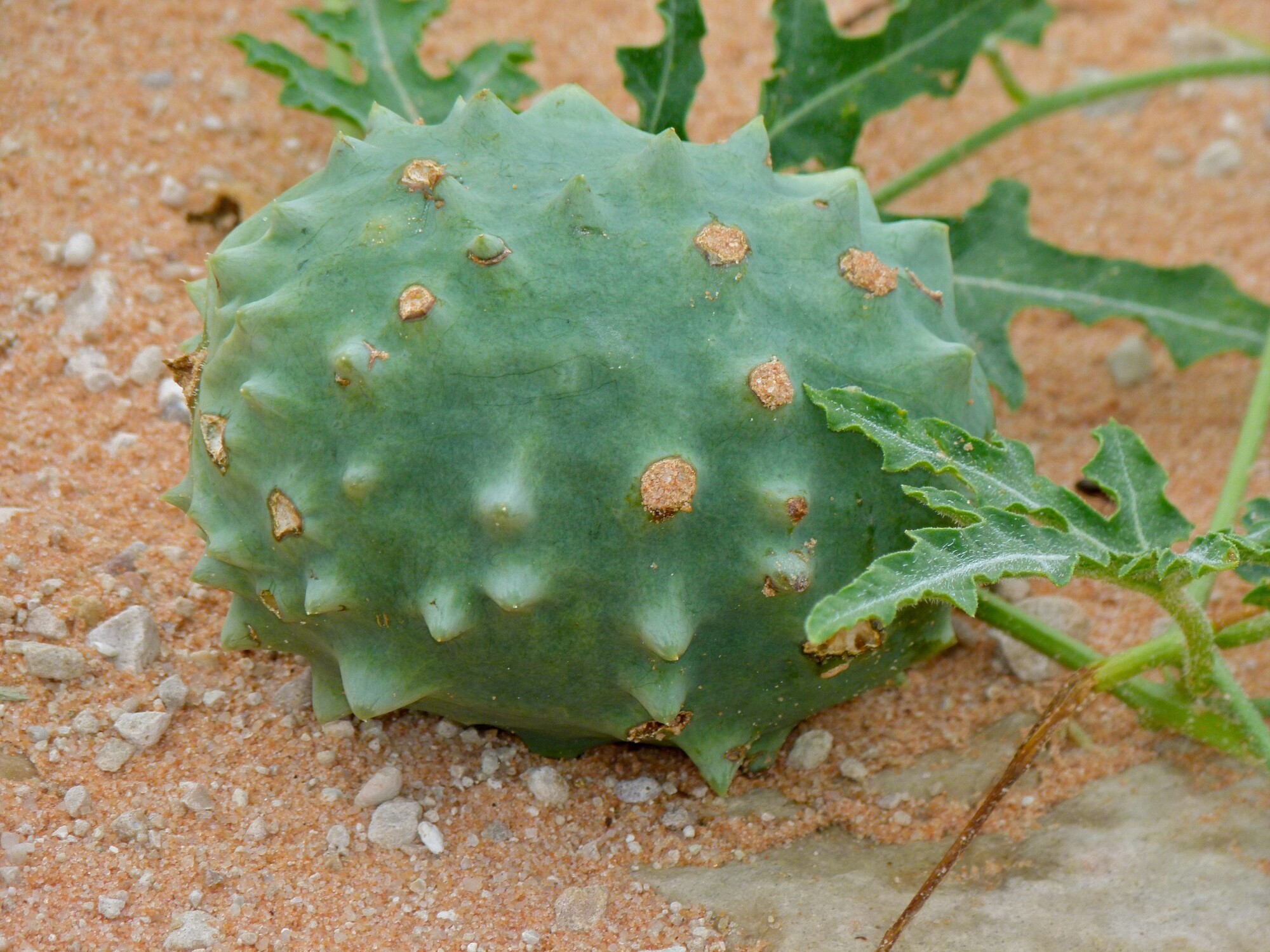
Inland, A. naudinianus follows a different blueprint suited to semi-arid savannas and Kalahari sands. Instead of a rigid, leafless shrub, it grows as a scrambling or climbing vine with tendrils and more conventional, lobed leaves, photosynthesizing rapidly when conditions permit. A large underground tuber serves as a reservoir, buffering the plant through long dry spells and resprouting after herbivory or drought. The fruits are smaller than those of nara but remain tough-rinded and spiny, with edible pulp consumed by wildlife. Porcupines and other mammals are known to dig for the tuber, underscoring its role as an energy store in lean seasons.
Both species share family traits—separate sexes on different plants, insect pollination, and a bias toward producing sizable seeds that pack oils and proteins rather than watery flesh. That seed strategy makes ecological sense in deserts: energy-dense seeds feed animals well, withstand desiccation, and supply seedlings with reserves for slow, cautious establishment. It also explains the plants’ cultural value. Seasonal harvests, drying racks, seed grinding, and oil pressing are woven into local lifeways, with knowledge of fruiting peaks, safe access routes across dunes, and respectful harvest practices passed down through generations.
Conservation concerns revolve less around direct overuse and more around hydrology and disturbance. A. horrida depends on the delicate balance of dune movement, fog frequency, and subsurface water; heavy groundwater extraction, off-road traffic that scours protective hummocks, or shifts in fog regimes can erode that balance. Protected areas along Namibia’s coast safeguard many populations, yet vigilance is warranted where tourism and development interface with dune systems. For A. naudinianus, land conversion and tuber digging can fragment habitats, though its resprouting capacity lends resilience.
In scientific terms, Acanthosicyos offers a compact lesson in convergent solutions to aridity—armored photosynthetic stems on the coast, storage-rich underground organs inland—tied together by a common cucurbit logic of separate sexes, insect partners, and resource-dense seeds. Few genera illustrate so plainly how anatomy, life history, and landscape dynamics braid together to make survival possible where rain is a rumor and sand never rests.
Additional Reading: Indigenous Plant Products in Namibia