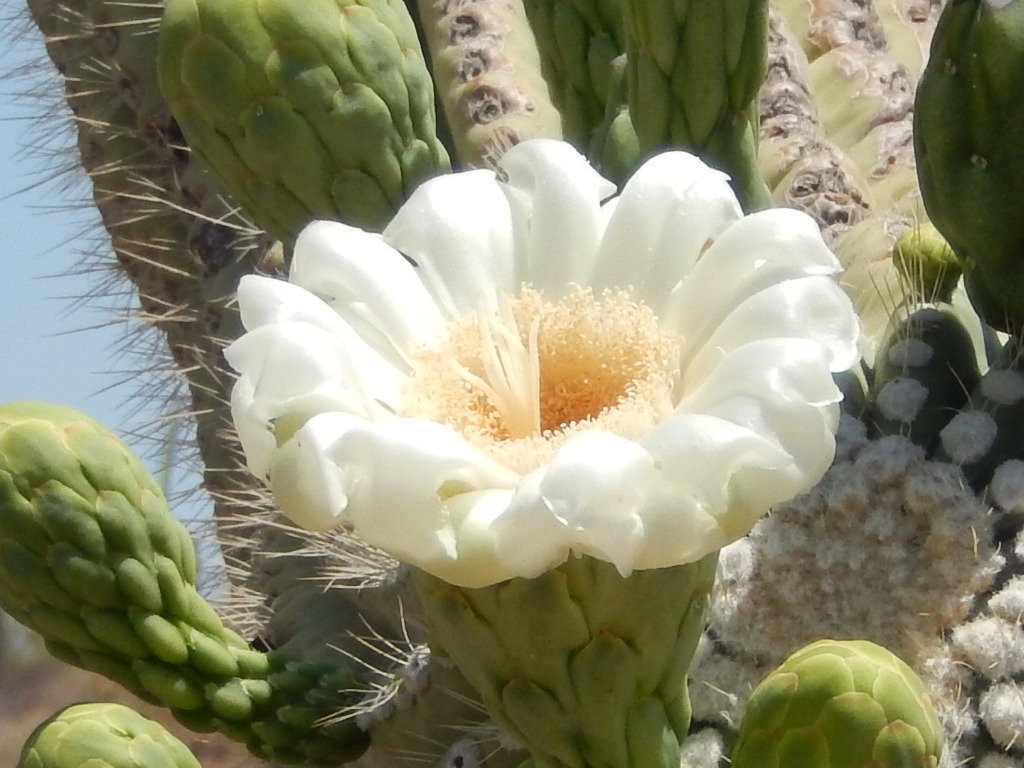
(Photograph = Sclerocactus parviflorus, Dorde Woodruff)
Introduction
The genus Sclerocactus is native to the southwestern United States and northern Mexico. Populations are scattered and often localized; several species have very small ranges and low overall numbers. Even where the plants are widespread, they tend to appear in pockets, tucked into the exact combinations of soil, exposure, and drainage they prefer.
The Details
Sclerocactus plants rarely branch. Most form small globes or short cylinders armored with dense spines, many of them hooked. Flowers and fruits are produced at the apex on new growth. The fruits dry at maturity. Flower color runs from greenish or yellowish to white, pink, and bright magenta, often looking oversized on such compact plants. Bloom is typically late winter into spring, timed to cool nights, bright sun, and brief pulses of moisture.
These cacti favor tough real estate—mineral soils, hot sands, clay flats, shale breaks, and windswept benches where water briefly pools, then vanishes. Many occur between roughly 2,000 and 5,000 feet (and higher), tolerate winter cold, and demand excellent drainage. In the same valley, you may find plants concentrated on one terrace and absent from the next, a reminder that microhabitat rules: slope angle, grain size, salt content, and exposure can matter as much as climate.
Identification within the genus hinges on spine character, rib and tubercle development, and flower and fruit details. Some species show prominent hooked central spines; others are mostly straight-spined. Stems may be bluish or olive-green, ribs can be sharp or low, and areoles range from tidy to shaggy with bristles. On mature plants, the armoring can be so dense that the body is hardly visible except at the actively growing apex.
How many species exist depends on the treatment. Benson recognized eight:
-
S. glaucus
-
S. mesae-verdae
-
S. wrightiae
-
S. pubispinus
-
S. spinosior
-
S. whipplei
-
S. parviflorus
-
S. polyancistrus
Other authors have accepted broader lists—fourteen, at one time—including:
-
S. brevihamatus
-
S. glaucus
-
S. mesae-verdae
-
S. nyensis
-
S. papyracanthus
-
S. parviflorus
-
S. polyancistrus
-
S. pubispinus
-
S. scheeri
-
S. sileri
-
S. spinosior
-
S. uncinatus
-
S. whipplei
-
S. wrightiae
Additional names have been published, such as S. brevispinus, S. wetlandicus, and S. johnsonii. The tiny, enigmatic Toumeya papyracantha is sometimes folded into Sclerocactus. Taxonomic opinions continue to shift as fieldwork and herbarium study refine distributions and variation.
Because many taxa are rare in habitat and finicky in cultivation, Sclerocactus presents both a challenge and a strong allure to hobbyists and collectors. Several species are conservation priorities, threatened by habitat disturbance and illegal collecting. Ethical growers work from seed and documented, legally obtained stock.
Cultivation notes, briefly: use deep, narrow pots; a very mineral, fast-draining mix; and bright light with moving air. Water sparingly during warm growth, then keep nearly dry in cold weather. Seed has a hard coat and benefits from patience, careful moisture, and a wide day–night temperature swing. With methodical care, the plants reward you with tidy symmetry, bristling armor, and—when your timing is right—apexes crowned with surprisingly large, luminous flowers.
Regional groups—such as the Utah Native Plant Society—have made substantial contributions to field knowledge, distribution mapping, and conservation awareness for the genus. Their efforts, and the care of conscientious growers, help keep Sclerocactus visible on the landscape and in carefully tended collections.
Additional Reading: Uinta Basin Hookless Cactus Complex