Introduction
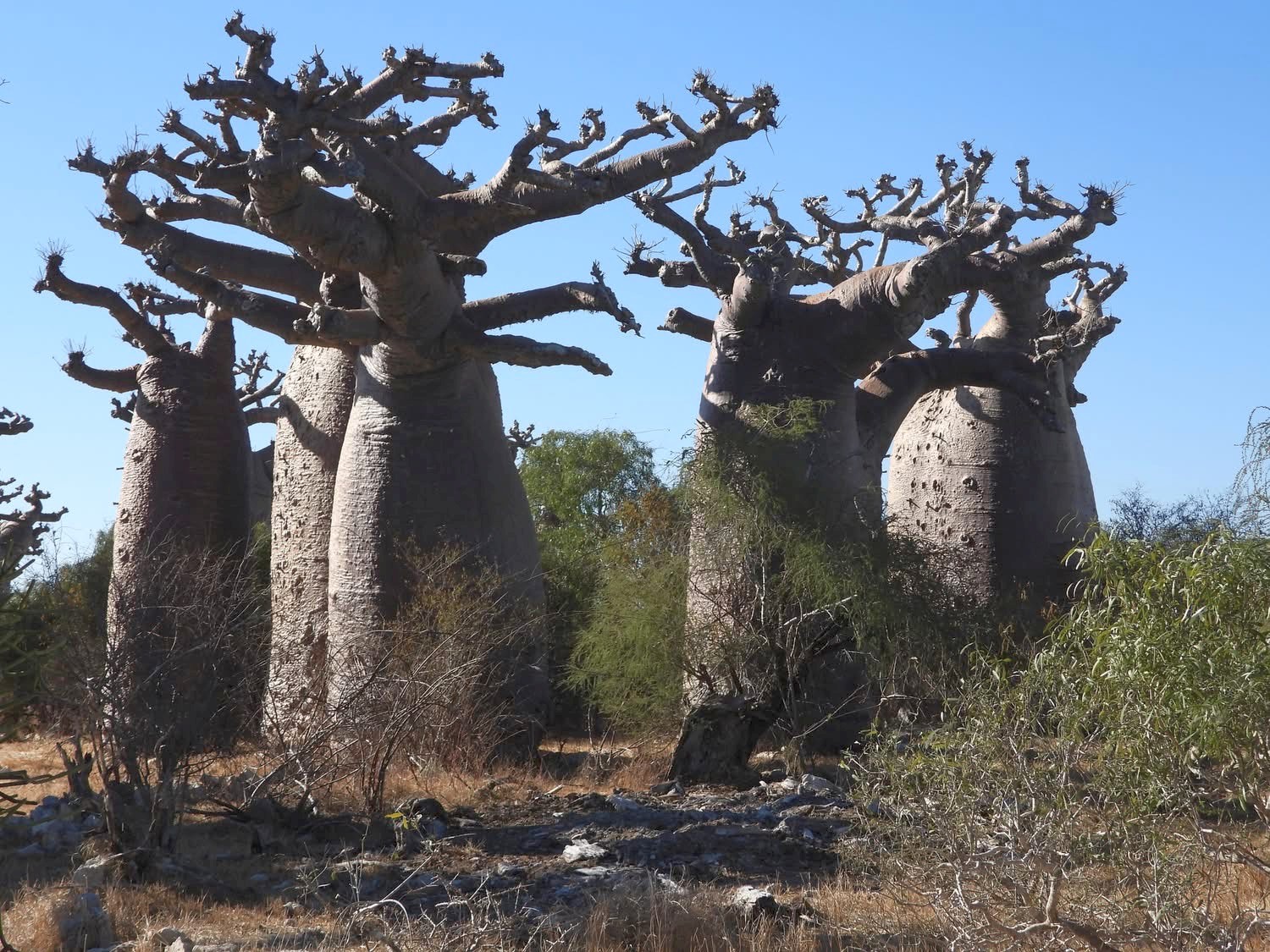
Adansonia grandidieri—Grandidier’s baobab—is the outsized silhouette most people picture when they think of Madagascar. It’s the biggest and most conspicuous of the island’s six baobab species, common on postcards yet increasingly uncommon on the ground. Along the Avenue of the Baobabs near Morondava, the trunks rise like weathered columns from a flat plain; elsewhere the species hangs on in scattered stands and along old field margins. Endemic to the island’s west, it now faces the familiar squeeze of land clearing, frequent fire, and a worrying lack of young trees to replace the elders.
The Details
This is the classic pachycaul: a vast, water-laden trunk with smooth, reddish-grey bark that looks almost poured, often around 3 m in diameter and 25–30 m tall, topped by a broad, level crown. The primary branches thrust out nearly horizontal before turning up at their tips, giving the tree its table-like profile. Leaves are palmately compound, typically with 9–11 narrow leaflets; fine hairs on the young foliage can lend a faint bluish cast in raking light. The wood inside is spongy and fibrous—more reservoir than timber—an adaptation to long, dry months.
The rhythm is seasonal and pronounced. Foliage flushes with the rains; then, in the dry season, the trees put on large, white, dusk-opening flowers that fill the air with a heavy, nectar-rich scent. Bats are the usual visitors, brushing their faces with pollen as they probe the flower tubes, though moths and other nighttime insects show up, too. Later come the fruits: big, velvety ovals with a hard shell, each packed with seeds set in a chalky, acidic pulp that people eat fresh or dried. Mature fruits hang like ornaments from long pedicels, sometimes persisting well into the next leaf season.
Historically, A. grandidieri dominated the lowland dry deciduous forests and seasonal river margins of southwestern and western Madagascar. Today it persists most visibly in human-shaped landscapes—fallow fields, roadside verges, and the edges of villages—where the giants were spared because they were useful or simply too impressive to cut. Local communities strip narrow panels of bark to twist strong fibers for rope and thatch, press a pleasant oil from the seeds, and use the vitamin-rich pulp as food. Simple ladders of wooden pegs tapped into old holes let harvesters climb the trunks for fruits, a practice that can span generations on the same tree.
The threats are several and compound. Clearing for agriculture and charcoal production removes seedlings and the small saplings that would be the next cohort. Frequent grass fires scorch the base and can kill young plants outright. In many places, intense grazing and trampling make natural recruitment rare; you can walk for kilometers among centenarian trunks without seeing a true juvenile. The result is a population heavy on elders and light on replacements. Yet where fire is managed and disturbance is low, seedlings do appear, and the species proves resilient—slow, but resilient.
These plants were growing north of Andavadoaka on the West Coast of Madagascar.
Photos by Amante Darmanin.
Related Reading: The Uses of the Baobab