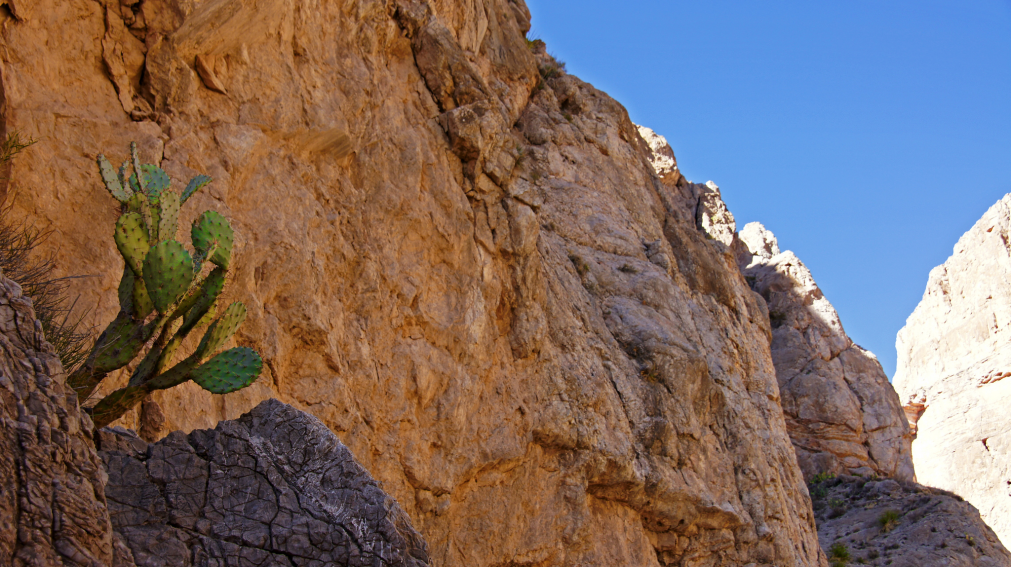
(Photograph = Opuntia spinosibacca, Patrick Denker)
Introduction
Cliffs and bluffs along rivers can be home to many cacti and other succulents. In particular, sheer faces, narrow ledges, and talus fans create fast-draining, low-competition niches where drought-adapted plants thrive. Similarly, coarse, rocky soils at the base of the cliffs—often a mix of gravel, sand, and broken stone—provide the quick runoff that many species prefer.
The Details
Steep cliffs can be difficult for cacti to colonize, but they can also function as safe havens, largely out of reach of browsing deer or cattle and buffered from frequent trampling. On exposed ledges, limited soil accumulates in cracks and small pockets; after storms, seeds settle into those crevices, and fine roots follow the fracture lines for moisture. Gentler, stepped slopes and talus cones are easier to colonize, especially where frost drains downslope on clear nights and where sun-warmed rock keeps the root zone slightly warmer in late winter and early spring.
Contrary to popular belief, many cacti do not prefer pure sand. Most perform best in rocky, fast-draining substrates with a little mineral fines and only modest organic matter; those mixtures allow rain to pass quickly yet retain a thin film of moisture around the root hairs. Along western rivers, seasonal flows scour competing vegetation from gravel bars and lower ledges, then leave behind fresh seedbeds. Detached cladodes that tumble during floods may lodge on a ledge or in talus; once a pad anchors, it can root and start a new clone—an efficient, vegetative route into otherwise hard-to-reach microhabitats.
Aspect matters. On south- and west-facing walls, intense afternoon sun and reflected heat favor species with thicker cuticles, upright or edge-on pad orientations, and dense glochid/spine armature that shades the surface. On north- and east-facing walls, cooler conditions and longer dew periods may allow thin-soiled moss–lichen films to form; those biofilms trap dust, slow runoff, and create seed “landing pads.” Substrate matters as well: friable sandstone yields pockets and shelves; columnar basalt produces narrow joints and quick drip-lines; limestone, with its fissures and solution pits, offers deep rooting cracks and slightly alkaline leachates—all of which shape which cacti and companions establish.
The West holds many rivers bordered by gentle to very steep cliffs, and many of those settings are ideal for cactus growth. Beyond the Southwest, the Midwest and East support Opuntia on fast-draining river bluffs and glacially carved escarpments. Sometimes O. humifusa occupies surprisingly sparse, rocky sites above a river—yes, even in New York state—where thin soils and rapid runoff mimic the open, competition-free conditions of drier regions. In canyon country, species such as O. polyacantha can persist on lava-derived rubble and ledges, while barrel cacti (Ferocactus spp.) hold to coarse, cobble-strewn benches above the floodplain. Outside North America, similar cliff-edge and canyon-rim patterns appear wherever drought, heat, and fast-draining substrates intersect, from tree aloes perched on African canyon rims to other succulents clinging to talus and ledges.
Additional Reading: Grand Canyon National Park Map