Introduction
Delosperma is a genus of small, sun-loving succulents in the ice-plant family (Aizoaceae), native mainly to southern and eastern Africa. Their leaves are plump and sprinkled with clear, glistening cells that look like tiny beads of ice, a feature that inspired the common name “ice plant.” In spring and summer they open bright, daisy-like flowers in pink, orange, yellow, or white. Most species creep over rocks and sandy flats, forming low mats that ride out long dry spells by storing water in their tissues. Despite their delicate look, Delosperma plants are tough and adapted to heat and cold.
The Details
At a glance, Delosperma shows a simple plan: opposite pairs of fleshy leaves on short stems, with many narrow “petals” surrounding a ring of stamens. Up close, useful details appear. The “ice” is made by large, clear surface cells that act like tiny water tanks and mirrors, storing moisture and reflecting intense sunlight. The leaves carry out CAM photosynthesis (Crassulacean Acid Metabolism), a water-saving strategy in which pores open mostly at night to take in carbon dioxide, helping the plants conserve water during hot days.
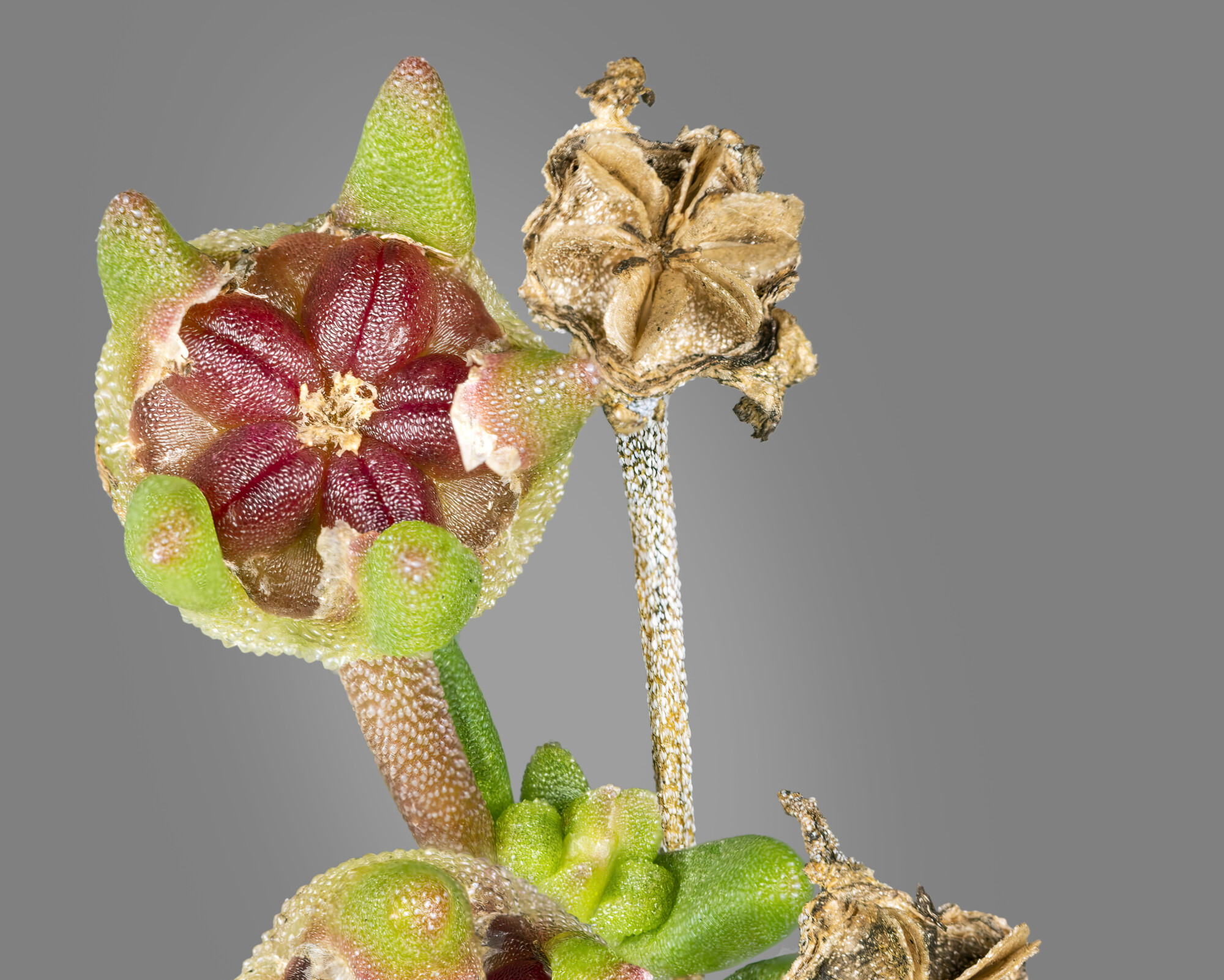
The flowers are designed for sun. Many species open fully only in bright light, presenting a wide disc to bees, flies, and small beetles. After pollination, the fruits develop into dry capsules with a clever rain-triggered door system. When raindrops wet the capsule, special tissue swells and the valves spring open; drops striking the seed cup splash the tiny seeds outward. As the capsule dries, the valves close again, protecting the remaining seeds until the next storm. This timing places seeds on the ground when moisture is available, increasing their chances of germination.
Delosperma is diverse, with dozens of species ranging from warm coastal areas to high, windswept mountain slopes. Some—such as D. cooperi and D. nubigenum—form dense carpets only a few centimeters tall; others make looser cushions on gravelly fans or cling to cracks in basalt or sandstone. Leaf shape, color, and texture vary: some species have smooth, cylindrical leaves; others bear flattened blades edged with tiny teeth. Flower color can shift even within a species, creating splashy displays across rocky outcrops.
In the wild, these plants stabilize shallow soils, slow erosion on slopes, and create small microhabitats where other organisms can live. Their mats shade the ground, reducing temperature swings and preserving pockets of moisture. Fragmented stems can root naturally and extend a colony, while the seed “splash-cup” helps new patches form nearby. Although many species are widespread, others occupy very small ranges and face pressure from habitat loss, mining, and trampling. As low, long-lived succulents adapted to harsh climates, Delosperma species embody a simple idea: survival by thrift—store water, spend it wisely, and synchronize life’s key moments with the rain.
Additional Reading: Delosperma cooperi