Introduction
Pseudolithos migiurtinus is endemic to northeastern Somalia (the old Migiurtinia region, including localities around Eyl). It grows on open, stony grit in full sun under desert to semi-desert conditions—genuinely arid terrain rather than merely “slightly arid”—within desert/dry-shrubland biomes.
Bottom line: this is a true arid-land stapeliad that lures small flies with carrion-mimicking cues from tiny, dark, urn-shaped flowers; actual pollen transfer is done by minute midges and other saprophilous flies attracted by the ruse.
The Details
How it attracts pollinators
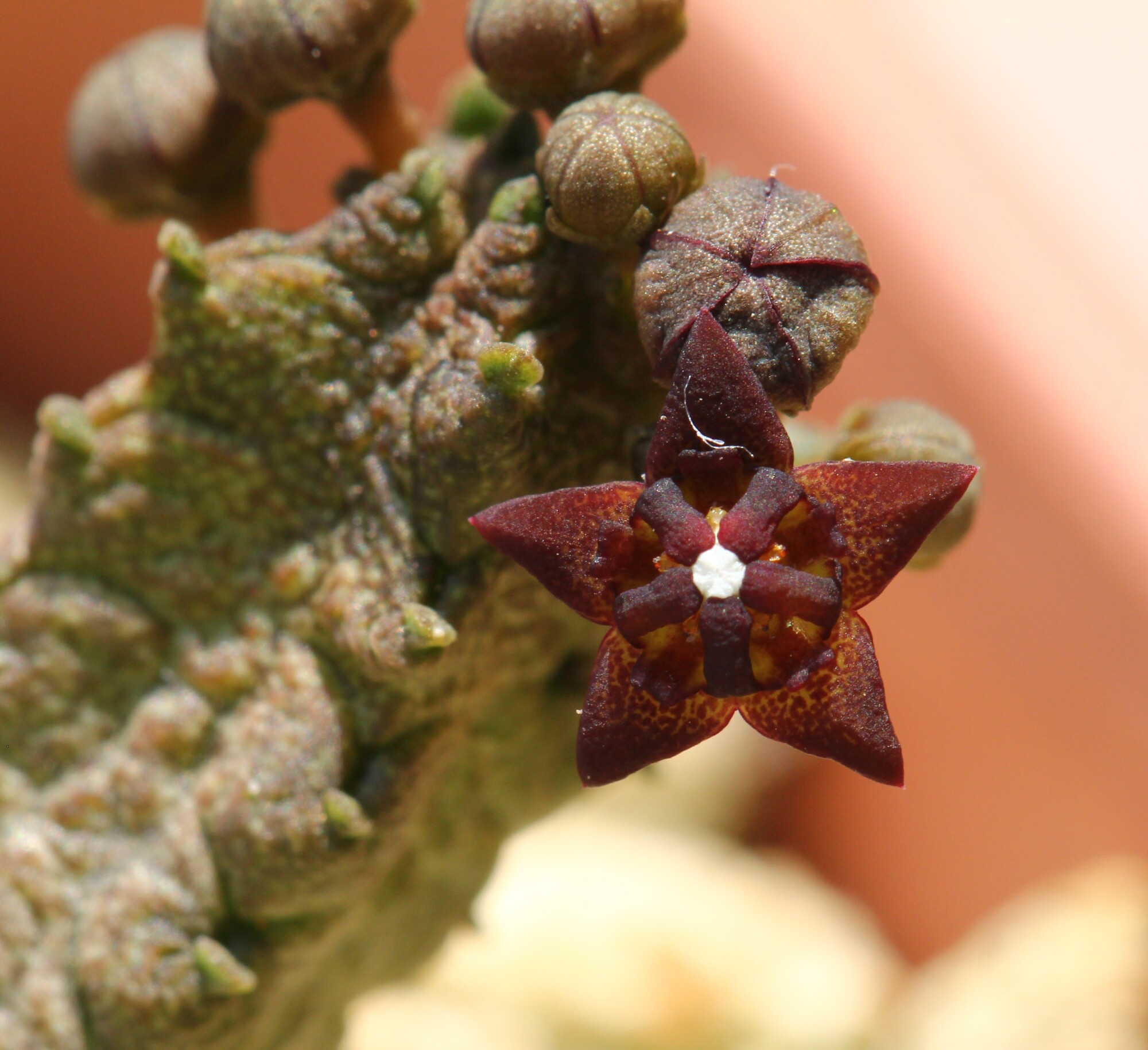
Like most stapeliads, P. migiurtinus uses sapromyiophily—mimicry of carrion/dung. The small, dark maroon to reddish flowers are urn-shaped with a narrow mouth and tufted lobe tips. A faint foul odor plus the color/texture guides flies to probe the flower throat and across the corona, where pollinia are picked up or deposited.
Pollinators (what visits/does the job)
Direct observations in the genus point to very small flies (midges) as effective pollinators. More broadly in stapeliads, saprophilous Diptera—blow flies, house flies, flesh flies—regularly visit and likely contribute to pollination of P. migiurtinus where it occurs.
What the plant looks like
A leafless, stone-like succulent, usually a single globose to short-cylindrical stem with a tessellated (“cobbled”) surface, typically 4–12 cm tall and ~2–6.5 cm across, colored green to ochre or reddish-brown depending on light stress. Flowers arise in small clusters; the tube is paler, the lobes deep red to maroon with short hairs. Fruits are the characteristic stapeliad paired follicles.
Additional Reading: Stapelia