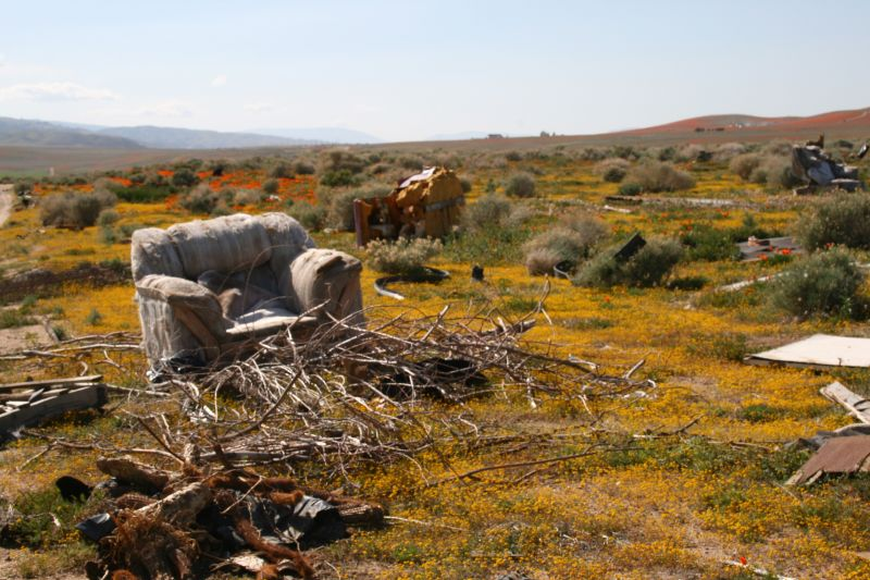
(Photograph = desert trash, Renee Silverman)
Introduction
The desert looks empty until trash snaps the spell. A glitter of glass, a tangle of wire, a drift of shot shells—once you see one piece, you see a dozen. Wind spreads light plastics for miles, and flash floods reshuffle everything down washes. Because the landscape is so open, every scrap reads loud. A little effort, done often, makes a real difference.
The Details
“Desert trash” comes in a few predictable flavors: plastic bottles and bags, aluminum cans, mylar balloons, shot shells and clay fragments, pallets and plywood, tires, furniture, and the occasional full-on dump of construction debris. You also find snaggy wire, fishing line near springs, and broken glass where people camped or target-shot. It all weathers slowly, and it all looks worse with time.
If you decide to help, think safety first. Wear puncture-resistant gloves, closed shoes, and eye protection; use a grabber if you have one. Avoid sealed containers with unknown liquids, heavy or sharp items you can’t move safely, and anything that looks hazardous. For big messes, note the location and report it to the land-management office rather than risking injury.
Pack a few basics so cleanup is easy, not heroic. Stash heavy-duty trash bags in your vehicle, plus a five-gallon bucket for glass and a small rake or dustpan for scattered fragments. A quick sweep around campsites and pull-offs adds up over a season. Sort recyclables at home if your local program accepts them.
Be mindful of what not to remove. Cultural artifacts—old cans with soldered seams, glass with bubbles or embossing, weathered camp tins—belong where they are. Photograph, enjoy, and leave them in place. The rule of thumb is simple: pick up modern litter, leave history.
The goal isn’t to sterilize the desert, it’s to make it safer and cleaner for the plants, animals, and people that share it. Less loose wire means fewer entanglements, fewer sharp edges means fewer punctures for wildlife and pets, and fewer bright bits means fewer temptations for curious birds. Most of all, it keeps the focus where it belongs—on open sky, quiet ground, and the life that knows how to live there.
Carry a bag, take a minute, and leave each stop better than you found it. The desert will show the difference.
Related Reading: Beneficial Soil Fungi and Pollution



Hello Joe,
In 1994 Dave Ferguson and I travelled through Mexico, from El Paso down under Mexico City and along the coast back to Phoenix. I remember very well that coming closer to a town was marked everywhere by the plastic bags hanging in bushes, 5 km from town it started, becoming denser and denser closer to town. Even a cardboard box laying in a dry area takes many years to decompose. I also remember piles of building trash between Ariocarpus (or on the Ario’s). Perhaps in time people will start cleaning these places but first people need to start realizing what valuable and vulnerable nature they have.
Of course the good memories are much more plentyfull!
Greetings, Robert in The Netherlands
Yes, you tend to expect this around human habitation. But in Peru, where chicken farms are freely dotted around the desert, it can take hours to pick the feathers out of cacti and terrestrial Tillandsia before they are fit to have their picture taken!
They call it ‘progress’ and ‘civilization’ – go back a few pages and have another go!
Cheers
PK
Very true–trash in the desert lasts for a long, long time because it is so dry. At least chicken feathers will eventually decay–plastic takes a lot longer. :(