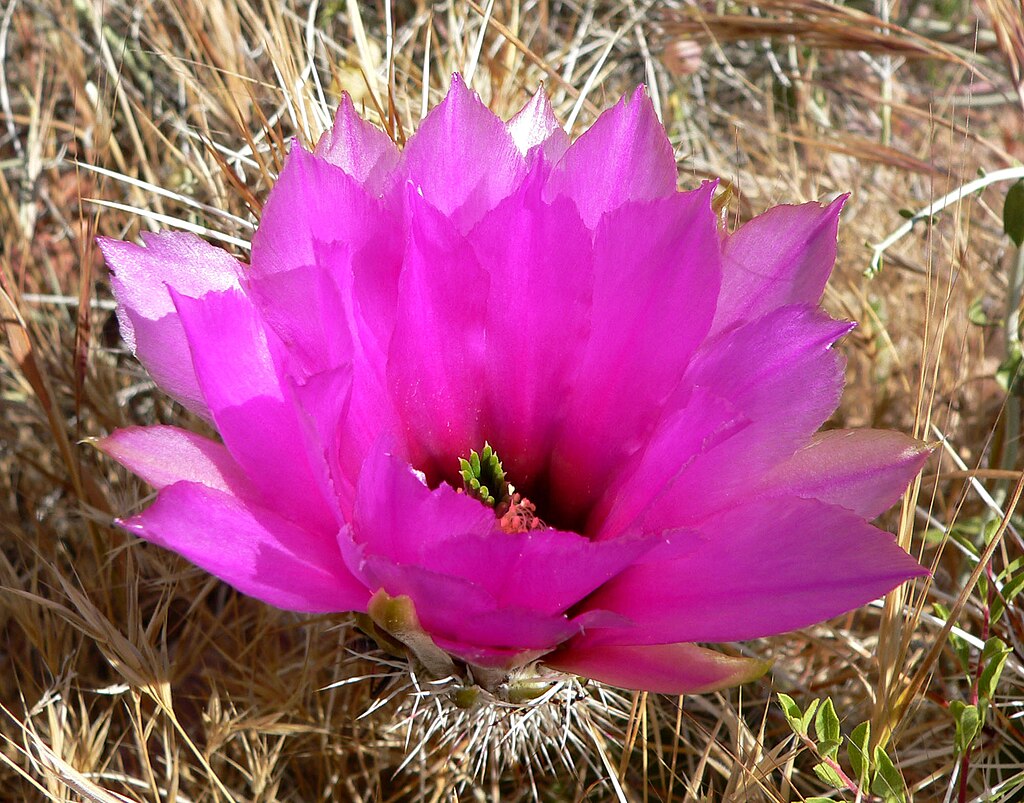
(Photograph = Echinocereus engelmannii, Stan Shebs)
Introduction
Echinocereus engelmannii—Engelmann’s hedgehog cactus—earns attention twice over: day-bright flowers in magenta to rose-purple, and tight mounds of upright stems that look sculpted out of spines. It’s a child of the Mojave and Sonoran deserts, scattered across rocky slopes, gravel fans, and limestone breaks from California and Nevada into Arizona, Utah, and northern Mexico. In good winters, spring brings a sudden bloom—large, funnel-shaped flowers with vivid green stigma lobes, a beacon for native bees. Later, fleshy fruits ripen and feed birds and small mammals. For gardeners, the draw is clear: compact size, clean lines, and a show that arrives right when desert landscapes lean spare.
The Details
Plants usually grow in clusters—two to dozens of stems—each cylindrical, evenly ribbed, and bristling with dense areoles. Spine color runs the gamut, from chalk-white through straw to copper and brown, sometimes banded so the stems read as subtly ringed. New growth sits a shade paler, then deepens with age and sun. Flowers open from the upper stems in spring, by day, and can span several inches across; throats glow, anthers ring the center in yellow, and the green stigma stands out like a star. Fruits follow quickly, starting spiny and easing smoother as the bristles weather; when fully ripe they’re sweet, seedy, and unmistakably attractive to wildlife.
In habitat, this species lives where water arrives in brief, fierce pulses. Stems store what they can, ribs flex like bellows after rain, and the skin’s bloom and spines cut wind and glare. You’ll find clumps tucked at the base of boulders, along fractured ledges, and in open, gravelly flats where competition is thin. Local forms vary—some squat and tightly armored, others a bit taller and looser—but the combination of magenta flowers, even ribbing, and that bright green stigma is a steady field cue.
Cultivation is straightforward if you follow the desert’s rules. Give full sun, a lean mineral mix, and ruthless drainage; a wide, shallow pot or a crevice-style bed suits it well. Water in distinct pulses during warm weather, then let the mix go bone-dry. Keep winter bright, cool, and on the dry side. Well-established plants tolerate brief, dry-cold dips into the teens, Fahrenheit—far better than prolonged cold paired with wet soil. Most troubles trace to heavy mixes, pots with small or clogged drain holes, or watering in cool weather.
For identification, compare it with the claret-cup group: those wear scarlet flowers and darker throats, while Engelmann’s hedgehog runs magenta with a clean green stigma. Against taller, looser hedgehogs, this one is more compact and evenly ribbed. In the landscape, site it away from footpaths—the spines are honest—and let it share space with companions that like the same lean, fast-draining conditions. Done right, you get a low-maintenance, sun-loving clump that looks sharp all year and lights up the garden when spring turns on the switch.
Related Reading: Echinocereus Online Journal