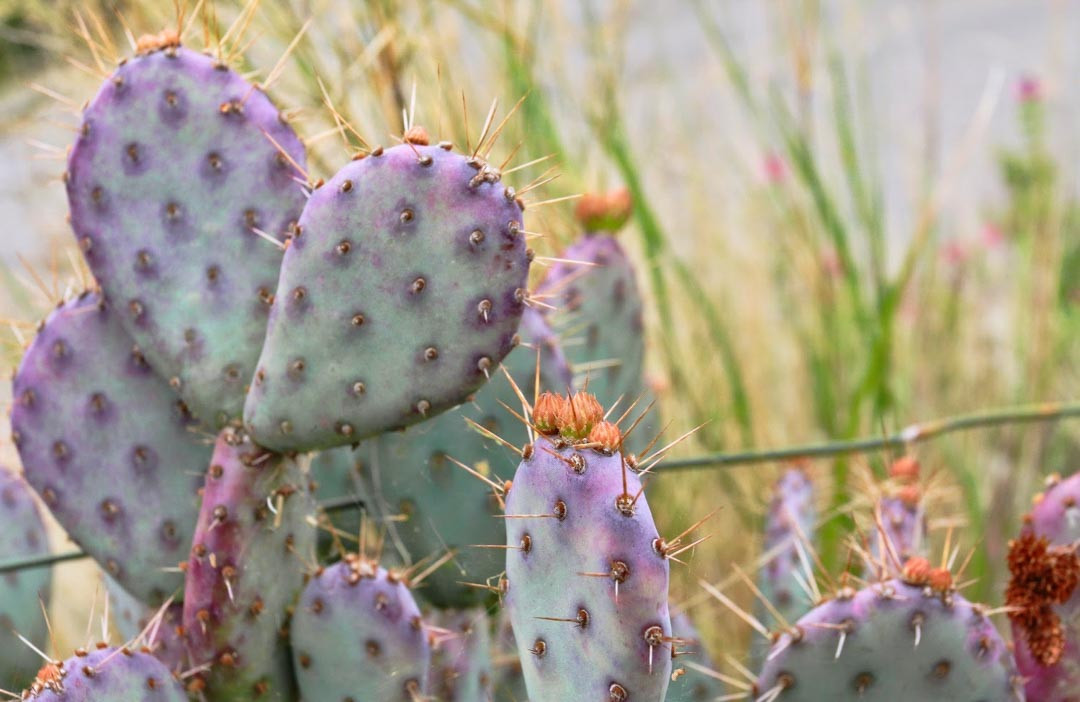
(Photograph = Opuntia basilaris x O. santa-rita hybrid, Chris Ginkel)
Introduction
Beavertail cactus—Opuntia basilaris—hybridizes readily where it overlaps with other prickly pears. In gardens, one frequent partner is the purple-padded O. santa-rita (the familiar “Santa Rita” prickly pear used in Southwest landscapes). When those two bloom together, you sometimes get offspring that wear both parents on their sleeves: lavender-gray pads with a powdery bloom, the fine glochids and gentle posture of basilaris, and a scatter of real spines, borrowed from santa-rita. Flowers tip their hand, too—pink pushed toward peach or soft orange, yellow washed with rose, green stigma lobes standing clear. It’s a good reminder that opuntias are not fixed statues. They trade pollen when timing and neighbors line up.
The Details
Field and garden clues stack up. Pure basilaris is usually spineless (glochids only), with matte, gray-green pads and magenta-pink flowers; santa-rita runs bluish to purple in cool, bright weather, with stout, pale spines and mostly yellow flowers that may carry a red throat. Hybrids often split the difference: thicker, lavender-gray pads that flush purple in winter; a few stout spines mixed with glochids; flowers in blended tones rather than the clean magenta or clear yellow of the parents. Fruit texture can hint at parentage—basilaris tends toward drier fruit at maturity, while many “Santa Rita” plants make fleshier fruit—so intermediate, half-juicy pods are not unusual on mixed plants.
A single cross is just the start. Where basilaris overlaps other members of the engelmannii/phaeacantha complex, you can see similar blends: a beavertail stance softened by purple or blue bloom, spination that comes and goes across the pad, flowers that refuse the neat boxes of “yellow” or “magenta.” In disturbed sites—road edges, washes below neighborhoods—hybrid swarms can form, especially when several species flower in step. In gardens, pollen moves on bees from plant to plant, and offsets get shared among friends; after a few seasons, beds can hold an unplanned genealogy.
If you like the look, treat these mixes as garden plants, not names to chase. Label with an “×” when you’re confident there’s blending—O. basilaris × O. santa-rita—or use “Opuntia hybrid (basilaris influence)” when parentage is uncertain. If the seed parent is known, list it first. Expect variation among siblings: one plant may lean spineless and rosy, a neighbor from the same seed lot may carry more spines and throw yellower blooms. Fertility is variable; many hybrids set some seed, especially when back-crossed to one parent.
Care is simple and strict. Give full sun, a lean, mineral mix, and ruthless drainage. Water in pulses during warm weather, then let the soil go bone-dry; keep winter bright and on the dry side. Site plants away from paths—the few spines they carry are honest—and allow space for pads to stack and show their winter color. If a clump shows traits you like, propagate from pads once they’ve calloused; if a seedling surprises you in a good way, let it prove itself through a summer and a winter before you share it.
For identification notes, photograph the whole plant and a single pad, then a flower face and fruit—those three angles usually tell the story. You may find yourself less interested in pinning a perfect name and more in watching how desert geometry mixes: the matte grays of beavertail, the winter purples of Santa Rita, and a bloom that lands somewhere between. That, in the end, is the appeal—the desert’s palette, recombined.