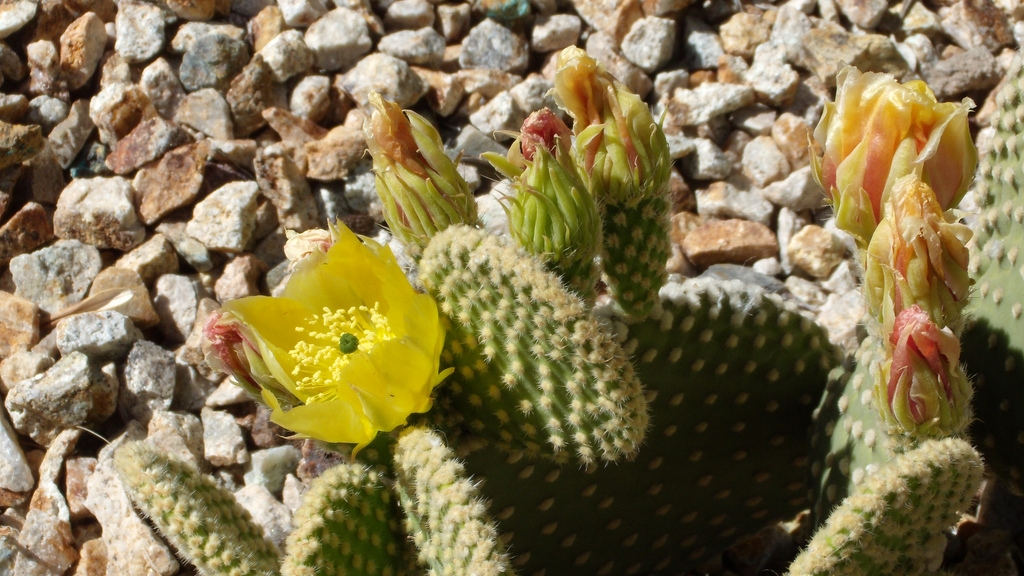
(Photograph = Opuntia microdasys, Dmitri)
Introduction
Few Opuntia lack true spines; O. microdasys is a uniformly small, shrubby Mexican species that bears only glochids. It is native to Coahuila, Hidalgo, Jalisco, Nuevo León, Querétaro, San Luis Potosí, Tamaulipas, and Zacatecas, and it does not occur naturally in the United States.
The Details
Plants form dense shrubs to ~0.6–1 m tall and 1–1.2 m across, branching from upper areoles. Cladodes are obovate to broadly oval, comparatively thin, and bright green; areoles are close-set in even rows and carry abundant white to yellow glochids; true spines are absent. Minute juvenile leaves are quickly deciduous. Buds are conical; flowers yellow; filaments pale to greenish; style light; stigma yellow. Fruits are oval to subglobose, maturing reddish-purple with areoles concentrated near the apex; seeds are pale and typical for the genus. The lack of true spines and the dense, even areolation diagnose the species in the field; it differs from O. leucotricha by its much smaller stature and absence of long, silky spines. Ecologically, it favors open sun and freely draining, often calcareous, substrates and tolerates only light frost.
Ecologically, O. microdasys occupies open Chihuahuan Desert scrub and thorn-scrub on calcareous gravels, limestone ledges, and well-drained alluvium. Juvenile pads often establish beneath nurse shrubs—Larrea, Flourensia, or Prosopis—then expand into exposed positions as clumps mature. Flowering follows spring warmth; generalist bees visit the yellow blossoms, and birds or small mammals take the fleshy fruits, dispersing seeds. Pads detach readily in high winds or after browsing, allowing vegetative spread where substrates are loose and dry.
In cultivation, success hinges on drainage and light. Use a strongly mineral medium—pumice or scoria with coarse sand over a small fraction of loam—and a container or bed that sheds water quickly. Water deeply in warm seasons, then allow the mix to dry completely; keep nearly dry and above freezing in winter. Full sun yields compact growth and dense glochid mats; shade produces elongated, tender joints. The species tolerates brief light frosts but is damaged by sustained hard freezes; outdoors it thrives in USDA 9b–11, and elsewhere it is best grown in containers. Propagate from clean, callused pads set upright without staking; roots form readily in warm, dry air. Common pests include cochineal scale and mealybugs; favor physical removal over oils, which can scorch pads in intense sun.
Additional Reading: Checklist of Chihuahuan Desert Cacti