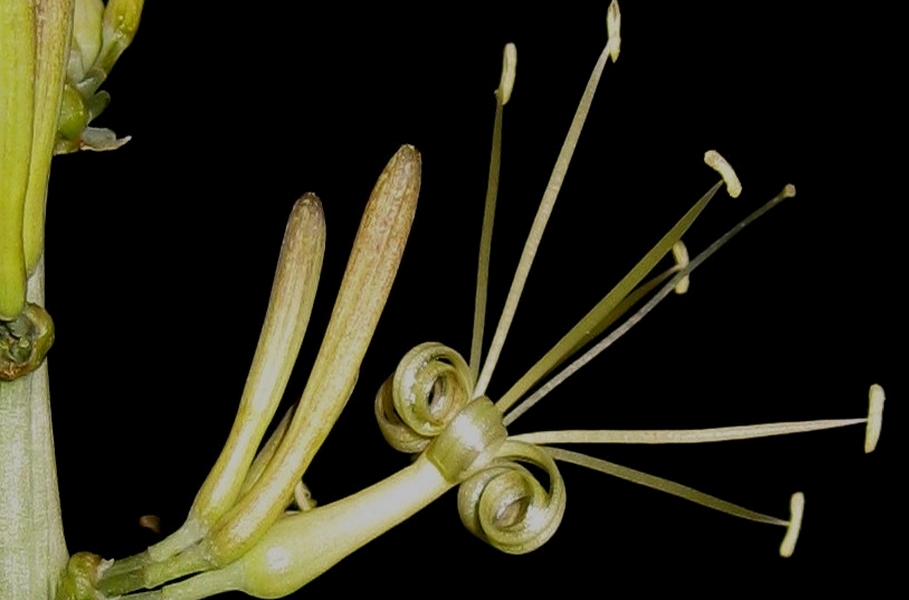
(Photograph = Sansevieria, Ton Rul)
Introduction
Sansevieria—the familiar “snake plants”—comprises roughly fifty to a hundred species native to Africa and parts of Asia. Species vary markedly in leaf form: some have terete, cylindrical leaves; others bear flat, sword-shaped blades. In habitat, mature clumps can reach 6–10 ft tall, yet many species remain modest in cultivation. Variegation occurs in several taxa and cultivars, presenting pale longitudinal bands or cross-banding that reads crisply against deep green tissue.
The Details
Vegetatively, plants are rhizomatous and typically form fans or rosettes of tough, fibrous leaves. The toughness comes from thick cuticles and reinforcing fibers within the leaf, which slow water loss and add rigidity. Cylindrical-leaved species often derive from drier sites; flat-leaved species are more frequently associated with somewhat mesic habitats. Leaves are usually entire-margined and glabrous; some taxa show pale or cream margins that accent the blade.
Inflorescences arise from the rhizome or from between leaf bases and elevate above the foliage. Flowers are small, tubular to narrowly campanulate, and typically white to greenish; they open in succession along the axis, often at night, and can be faintly to strongly fragrant. Fruits are berries that mature with one to a few seeds. After flowering, clumps continue by rhizome extension, so individuals persist as long-lived colonies.
In cultivation, Sansevieria is remarkably tolerant. As house plants, they handle low light, but they maintain better form in bright, indirect light; in stronger sun, a brief acclimation prevents scorch. Use a coarse, fast-draining, mineral-rich potting mix, and water thoroughly, then allow the mix to dry before the next irrigation. During cool, short-day months, reduce watering; during warm, high-light periods, water a bit more, yet still sparingly. Plants are not frost-hardy; protect from freezing temperatures, and avoid cold, wet soils.
Propagation is straightforward. Division of rhizomes preserves cultivars exactly; leaf cuttings also root readily, though variegation may not be retained in variegated clones. Routine grooming—removing senescent leaves at the base—keeps crowns tidy and encourages new growth from the rhizome. Pests are uncommon; if mealybugs appear in leaf axils, a swab and persistence usually suffice.
Additional Reading: Sansevieria hyacinthoides