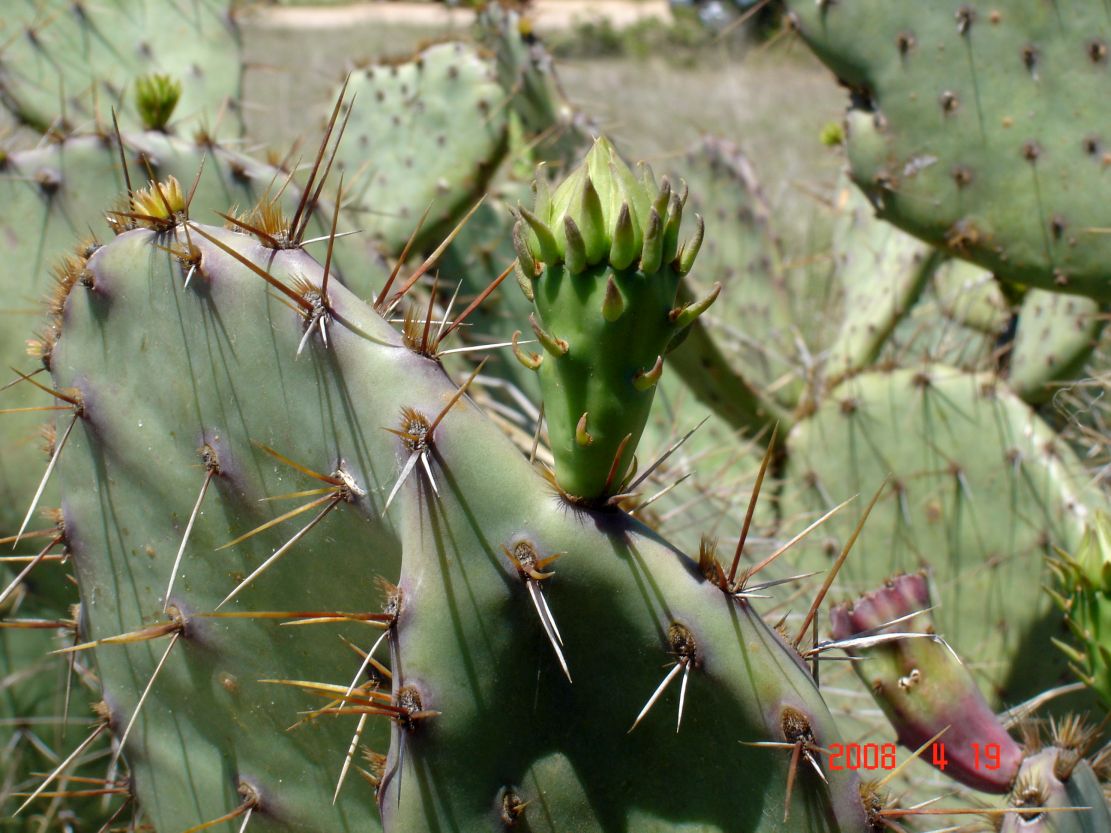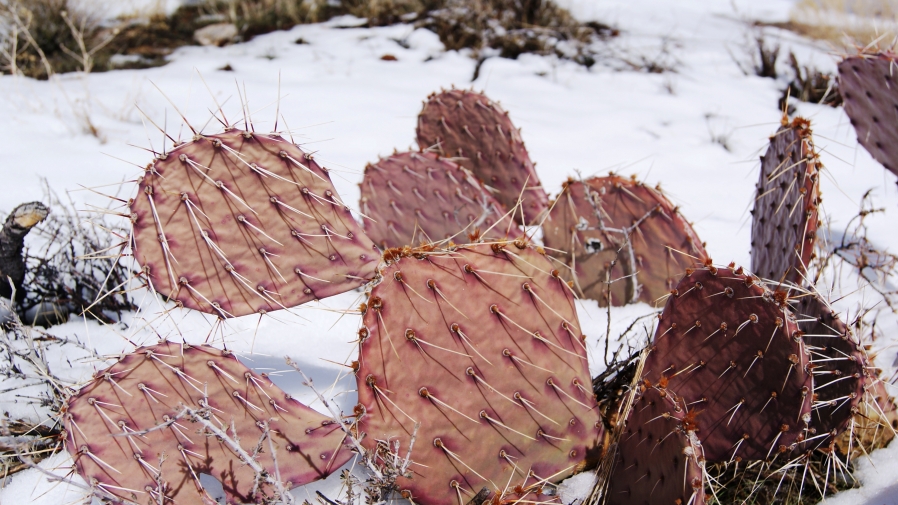
(Photograph = Opuntia mojavensis in winter)
Introduction
Opuntia mojavensis is an enigma. The only historical drawing shows two spine clusters and an immature fruit, and the lectotype sheet holds limited material. With so little to go on, matching living plants to the name is difficult.
The Details
Britton and Rose noted that the species was imperfectly understood. We observed a plant near the summit of Mt. Potosi, southwest of Las Vegas, that may represent O. mojavensis. The spines resemble those on the single, imperfect herbarium specimen. Cladodes are roundish, oval, or obovate—and the plant is notably more upright than O. phaeacantha. “More upright” here means more wood is produced: stems are sturdier and more ascending rather than sprawling. The spination also differs somewhat from typical O. phaeacantha.
The original description allowed that O. mojavensis might be a form of O. phaeacantha, yet it was described as a separate species. Our possible O. mojavensis was found at about 4,500 ft on Mt. Potosi. Based on the description, occurrences could lie west of the Colorado River in Nevada and California desert mountains, though precise localities remain uncertain.
A note on “lost” Opuntia names. Many older Opuntia names are difficult to apply because the original descriptions were brief, the illustrations were minimal, or type material is fragmentary or missing. Over time, some such names drift into synonymy or are treated as doubtful until a lectotype or neotype can be chosen and convincingly matched to real populations.
Opuntia mojavensis (Britton and Rose)