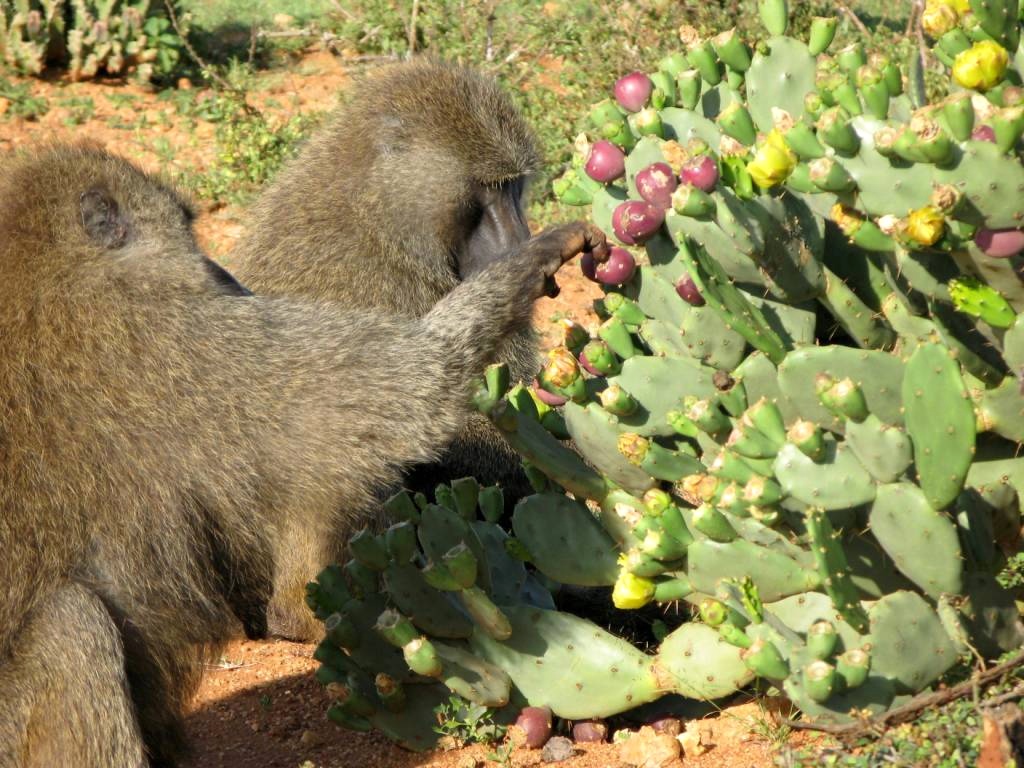
(Photograph = male baboons with Opuntia in Africa)
Introduction
It’s a mouthful of a title. What does it mean? Opuntiaphagous comes from two parts: Opuntia and -phagous. We all know what Opuntia means. Phagous (from Greek) means “eating.” So, opuntiaphagous means “eating Opuntia.” Vertebrates are animals with backbones—turtles, lizards, birds, cows, goats, and more.
The Details
Park Nobel edited a 2002 book about cacti. In Chapter 7, the authors described vertebrates known to eat Opuntia (or some part of an Opuntia).
Fruit is the most commonly eaten part, but seeds, nectar, pollen, cladodes, and even roots are also taken.
Tortoises, iguanas, and certain lizards eat various parts of Opuntia. Ostriches, emus, doves, and quail are all known to eat some portion, too. Rabbits, jackrabbits, ground squirrels, and sloths eat Opuntia. Gray foxes, porcupines, and black bears have been observed eating it. Bison, mule deer, and goats also consume Opuntia.
In all, 89 vertebrate species (including humans) have been reported to eat Opuntia. The authors note that the topic is seldom studied and many observations are incidental. Opuntias are studied a lot in the United States, so records may be uneven across regions. It’s likely that many more vertebrates eat Opuntia but simply haven’t been reported. To date, few comprehensive studies seem to exist.
Additional Reading: Vertebrate Consumption of Opuntias