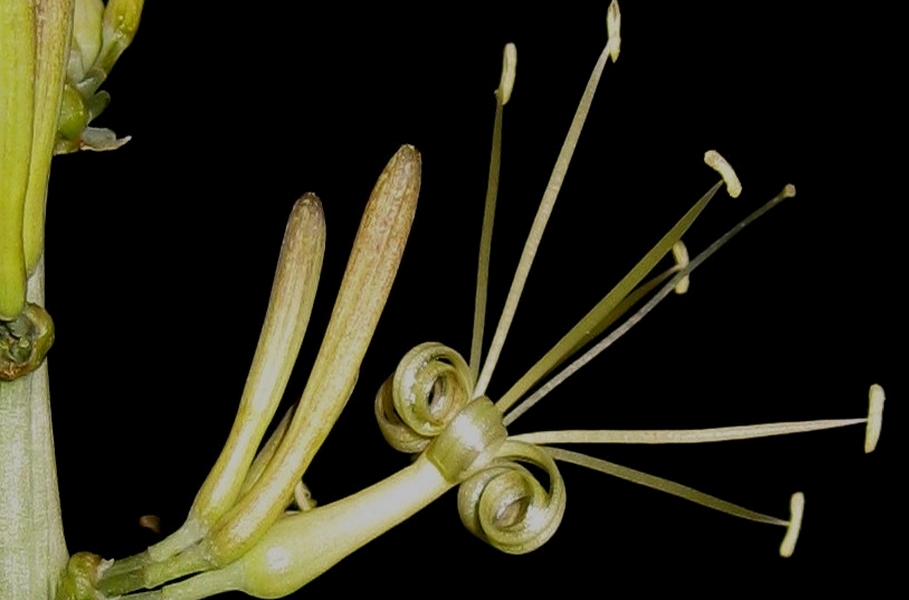
(Photograph = Crassula multiclava, 4-merous flowers, Jacinta Iluch Valero)
Introduction
Across southern Africa, and on windowsills worldwide, Crassula plants manage a neat trick: compact bodies that conserve water, and flower displays that look delicate but hold up in dry air. When people think of the group, they picture the jade plant, yet the genus runs from coin-leaved shrubs to tiny, cliff-hugging mats. In most species, the flowers are small, starry, and massed—pretty up close, and persuasive to bees, flies, and small wasps. Just as important, they are not always five-parted; many Crassula are 5-merous, while plenty are 4-merous.
The Details
In broad outline, Crassula flowers follow a repeating plan: sepals, petals, stamens, nectar scales, and free carpels. In many species, the count is five sepals, five petals, ten stamens, five nectar scales, and five carpels. In others, the count drops neatly to fours and eights—four sepals, four petals, eight stamens, four nectar scales, and four carpels. The ovary is superior, sitting above the point where other parts attach, and the carpels mature into many-seeded follicles. As a quick rule, the number of stamens is usually twice the number of petals.
In the field, or on a bench, petal posture and color tell you plenty. White and cream dominate, often flushing pink with age or cold nights. On jade plants, cool, bright winters trigger clouds of white stars with a light, honeyed scent. On cliff species, tight sprays open in succession, handing off pollen quickly before heat or wind shuts the show down. When drought stretches, plants hold back; after a good pulse of moisture, they stage fast, synchronized blooms that pull in everything with a tongue.
For a fast read in the garden, follow three cues:
-
Inflorescence shape. On shrubby species, flowers gather in rounded heads or candelabra-like clusters; on smaller species, they run in short spikes or branching sprays.
-
Merism (the part count). When you are sorting look-alikes, count a few blooms. Fours point one way in the key, fives another; a consistent count is more useful than leaf color alone.
-
Nectar scale form. At the petal bases, little tongues or pads mark the nectar; broad scales tend to feed generalist visitors, while narrow scales tuck nectar deeper and favor smaller insects.
For indoor growers, bloom depends on rhythm. In autumn and early winter, cool nights, bright days, and lean fertilizer nudge buds along. In spring, longer days keep the factory running just long enough to set seed. If a plant refuses to flower, check light first, then night temperature; most stubborn cases trace back to warm nights, heavy feeding, or shade.
In the end, Crassula flowers reward a closer look. With a hand lens, and with ten patient minutes, you can watch the traffic—pollen dust on a fly’s face, nectar scales glistening, and a star-shaped bloom that is cleanly four-parted, five-parted (or some species are even six-parted), depending on the species. Count a few, note the pattern, and the genus starts to come into focus.