Namaqualand Desert

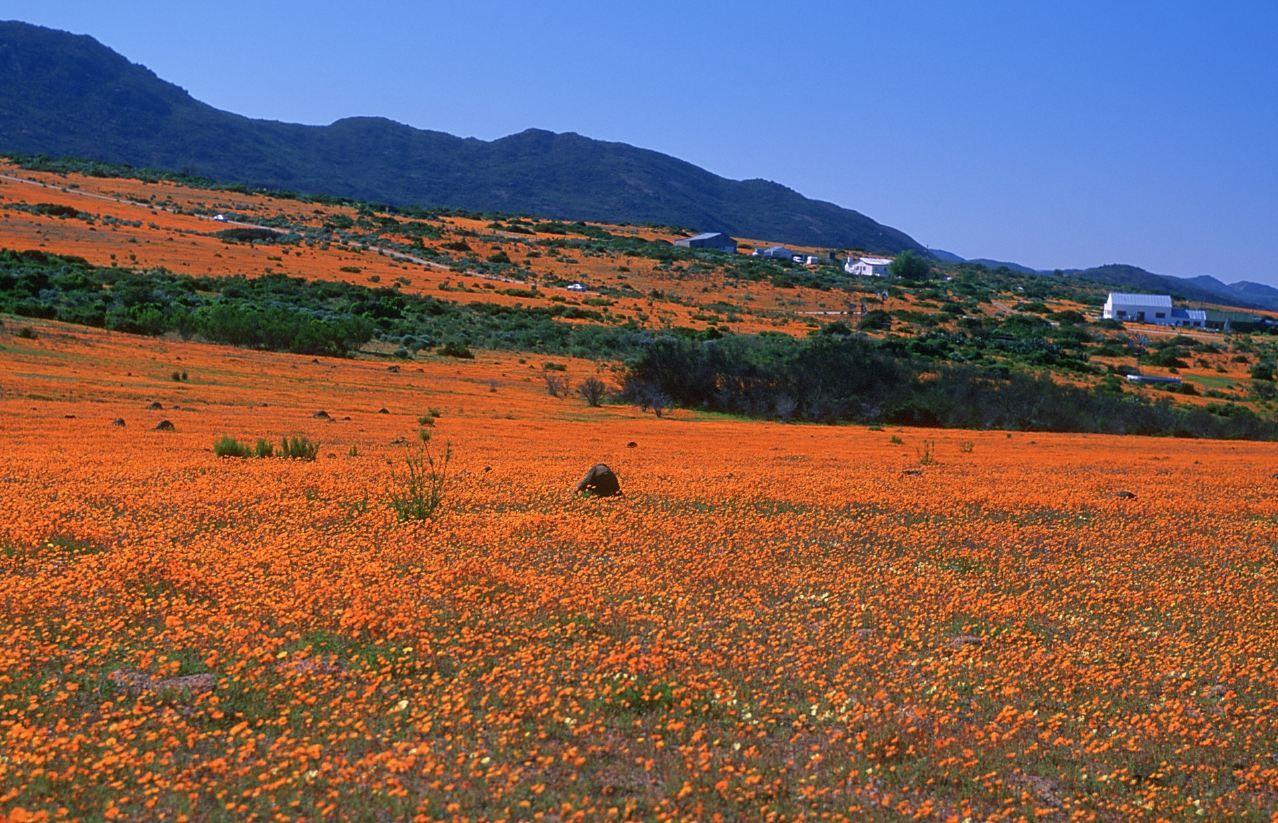
(Photograph = Namaqualand flowers, Malcolm Manners)

Introduction

South Africa, Namibia, and Botswana are home to vast deserts. The great Kalahari spans all three countries, while the Namib lines the Atlantic coast—chiefly in Namibia—and extends into southern Angola and South Africa. Together they frame some of the driest, most visually striking landscapes in Africa, where wind, sparse rainfall, and extreme temperature swings shape ecology and culture alike. Though often labeled “desert,” these systems grade into semi-arid shrublands and grasslands, creating broad transition zones that heighten diversity and seasonal spectacle.

Introduction

In far northwestern South Africa, and across the border into southern Namibia, Namaqualand lies where winter rain, cold fog, and hot inland winds meet. In late winter, the country reads as bone-pale quartz and tawny scrub; after the first good fronts, it snaps into color. For a few short weeks, daisies, vygies (Aizoaceae), and small bulbs paint whole slopes, while the succulents that carry the hard months—Cheiridopsis, Conophytum, Lithops, Tylecodon—quietly fatten and split their skins. In a dry year, the show is subtle; in a wet one, it feels unreal. In most seasons, late August into September is the safe window, but timing still belongs to the weather.

The Details

Along the coast, fog-laden mornings feed fields of annuals and cushiony mesembs tucked into grit. Inland on the Knersvlakte, white-quartz patches bounce light and keep roots cool; tiny stone-plants hide in the glare until a flower gives them away. On rocky hills toward the Richtersveld, dwarf aloes and Tylecodon perch in cracks, while leaf-ferns and stapeliads thread into shade behind boulders. In late afternoon, when heat drops, hawk moths and small solitary bees start their rounds; by night, carrion flies find the stapeliads.

On good slopes, you can read layers. Near your boots, flat rosettes and pebble-mimics—Argyroderma, Oophytum, Lithops—sit tight against the stone. A bit higher, shrubby daisies and restios catch the breeze. On ridgelines, old Tylecodon paniculatus hold the skyline like red-barked candelabras. After frontal rain, annual carpets race to set seed before dry wind returns; after fog-heavy weeks, cliff and quartz specialists gain quietly, cell by cell.

For orientation, think rhythm. In late autumn, many mesembs wake. Through winter and early spring, they drink sparingly from frequent, light rains and sea fog. By early summer, they seal up—sheathing leaves, tightening bodies, and waiting. With that cycle in mind, you can read the landscape: firm, sun-baked plains mark summer; friable, freshly patterned crusts mark winter moisture. Between those states, brief flushes invite pollinators, and whole valleys shift from grayscale to saturated color.

If you go, tread lightly on the crust and the quartz pans; a single heelprint can outlive the flowers it crushed. From tracks and pull-offs, scan at knee height first for annual color, then drop your gaze to the pebbles for the small, slow plants that make the place what it is. In bright sun, step sideways to change the angle—backlighting reveals the “pebble” rosettes; front light pulls flower color forward. In a short visit, you may see only a fraction of the flora; in several seasons, you start to notice the strategy—store when you can, shut down when you must, and spend on flowers only when the odds favor seed.

Additional Reading: Namaqualand

2 Comments

Add Yours →

Leave a Reply