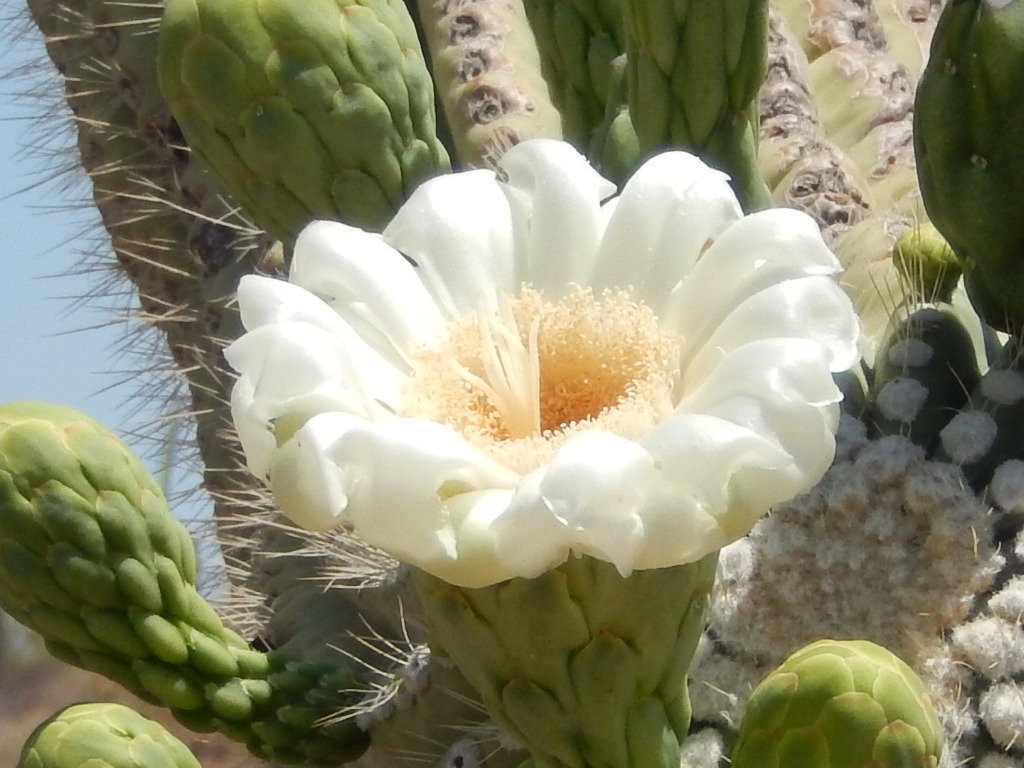
(Photograph = Cereus hildmannianus, el Cajon Yacht Club)
Introduction
Cereus hildmannianus is one of the cacti commonly called “queen of the night,” a name given to several night-blooming species with large, fragrant flowers. Native to southern South America, it grows as a tall, branching columnar cactus. Stems are blue-green to dull green with four to six ribs, and many garden plants are nearly spineless. Flowers open after dark and close by morning.
The Details
Habit and identification
With age, plants branch freely and can reach several meters. Stems are about 8–15 cm thick with sharp-edged ribs and small areoles. Typical cultivated plants have few or no spines, while the subspecies uruguayanus is more often armed. In bright exposures, stems keep a bluish cast; in heavier shade, they turn greener and elongate.
Flowers and fruit
On warm nights in spring to summer, buds open quickly into wide, white, funnel-shaped flowers that release a sweet scent and attract nocturnal pollinators. After pollination, spherical fruits ripen red to yellow with pale, juicy pulp and glossy black seeds. Birds and other animals eat the fruit and spread the seeds.
Range and habitats
Cereus hildmannianus occurs in southern Brazil, Paraguay, Uruguay, and northern Argentina. It grows on rocky outcrops and sandy, well-drained soils, sometimes leaning among shrubs or trees for support. In exposed, windy sites, plants stay shorter and thicker; in sheltered microsites, they grow taller and branch more.
Cultivation notes
For gardens or large containers, provide very bright light, a coarse, fast-draining mix, and deep but infrequent watering during warm growth. Allow the top of the soil to dry between soakings. In winter, keep cooler and drier to encourage bud set. Plants tolerate brief light frosts when dry, but prolonged cold is damaging. To manage size, prune a few arms after flowering and root the callused cuttings.
Quick distinction
If you are sorting night-blooming “queen of the night” plants, check stem form. Cereus hildmannianus has thick, ribbed columns (often nearly spineless), while many epiphytic night-bloomers have thin, flat or angled climbing stems.