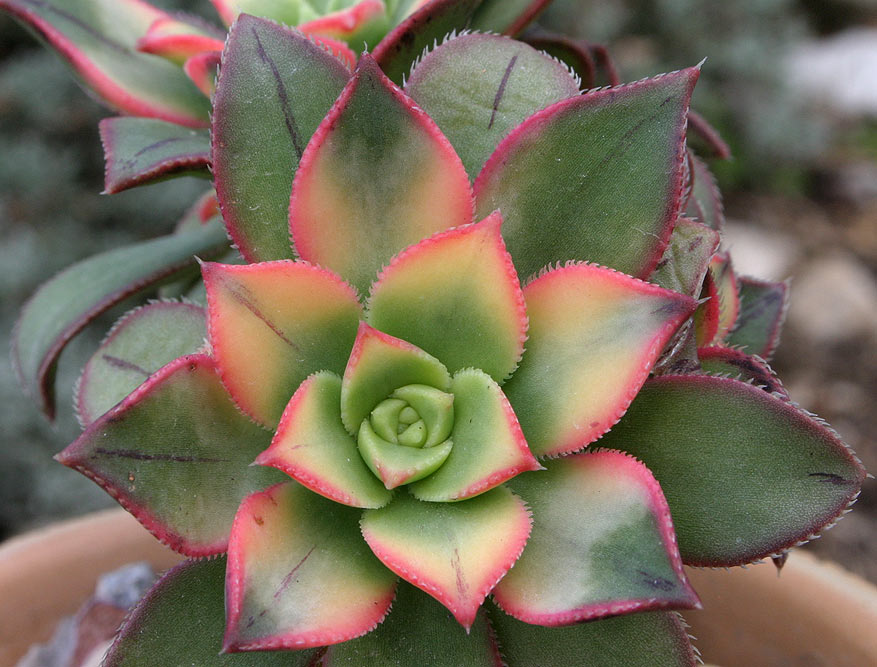
(Photograph = Aeonium haworthii, Manuel M Ramos)
Introduction
Within Crassulaceae, Aeonium is a rosette-forming lineage centered in Macaronesia, with its greatest diversity in the Canary Islands and outliers in adjacent North Africa. Most species are insular endemics that show striking variation in habit—from compact, ground-level rosettes to shrubby, branching forms with terminal crowns. As in many Mediterranean-climate succulents, growth is concentrated in the cool, moist season; during summer drought, rosettes typically contract and leaves overlap tightly, conserving water while maintaining a functional photosynthetic surface.
The Details
Vegetative morphology is diagnostic. Leaves are sessile and spirally arranged, forming terminal rosettes; blades are spatulate to obovate, typically entire-margined, and glabrous, though some taxa bear a fine ciliation near the base. Surfaces range from matte green to glaucous, with anthocyanic reddening common in high light or cool temperatures. Stems, when present, are often woody below and green above; branching is sympodial because each rosette is monocarpic—flowering terminates the axis, and renewal proceeds from lateral buds.
Inflorescences are terminal and many-flowered, commonly conical to pyramidal in outline. The basic module is cymose, repeated to form a compound panicle that elevates the flowers above the foliage. Flowers are actinomorphic and typically 6–12-merous; sepals and petals are free, with petals lanceolate to narrowly elliptical. Stamens number twice the petals and are inserted in two series. As in Crassulaceae generally, a nectariferous scale stands at the base of each carpel. The gynoecium is apocarpous, with as many follicles as petals; each follicle dehisces along the ventral suture to release numerous, dust-fine seeds.
Phenology tracks climate. In the Canary Islands and similar settings, leaf expansion and axis elongation occur chiefly from autumn to spring; summer brings a reversible quiescence, visible as tighter rosettes and shortened internodes. Post-anthesis, the flowering rosette senesces; however, because branching precedes or accompanies inflorescence initiation, clonal crowns persist as lateral rosettes mature, maintaining the overall individual.
Comparative characters help distinguish Aeonium from close relatives. Unlike Sempervivum, which is predominantly acaulescent and alpine-Eurasian, many Aeonium species carry rosettes on evident axes, and their seasonal rhythm reflects Mediterranean drought rather than frost-driven dormancy. From Orostachys, Aeonium differs in its woody, often arborescent axes in several taxa and in its insular radiation, which has produced suites of species differing in rosette architecture, leaf thickness, and inflorescence form.
Ecologically, Aeonium occupies cliffs, basaltic lava fields, xeric scrub, and margins of laurel forest, where shallow, fast-draining substrates and maritime humidity prevail. Pollination is primarily entomophilous, with floral displays timed to seasons of higher insect activity. Seeds are minute and readily dispersed; in contact zones, natural hybridization occurs, contributing to local polymorphism. Taxonomically, several rosette-forming elements historically segregated at generic rank have been included within Aeonium by many authors, reflecting close morphological and anatomical affinity across the group.
Additional Reading: Amazing Aeoniums



Looks good and delightful plants.