
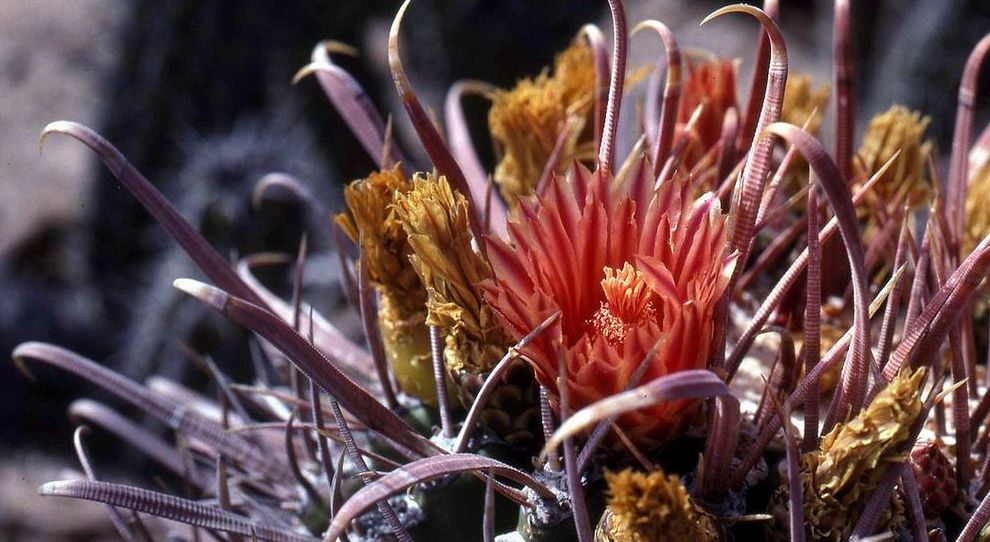
(Photograph = Baja California, Alan Harper)
Introduction
Cacti can grow in very poor, fast-draining substrates—even on bare lava. In those places, both water and nutrients are scarce. How do these plants get what they need?
The Details
The giant cardón (Pachycereus pringlei) often grows on old lava flows in Baja California, where available nitrogen, phosphorus, and other minerals are limited. Greenhouse work shows that bacteria living on cactus roots can help seedlings do more with less. When cardón seedlings were inoculated with rhizoplane bacteria and grown in pulverized igneous rock mixed with perlite, they fixed nitrogen, dissolved phosphate, and mobilized minerals from the substrate. Inoculated plants grew well for twelve months with no added fertilizer, while uninoculated plants lagged or died. The growing medium itself ended up with more plant-available nutrients than it started with.
“All inoculated plants, regardless of the bacterial species, grew much better and were more able to extract essential inorganic minerals from the pulverized rock … than plants that had not been inoculated.”
Some strains even improved survival in perlite alone, suggesting that the microbes can support seedlings under extremely lean conditions. These results come from controlled conditions, but the basic idea is clear: the right bacteria on cactus roots can unlock nutrients from rock particles and help explain how these plants establish on seemingly nutrient-poor sites.
Additional Reading: Growth Promotion of Cactus Seedlings on Rocks




Hi Joe,
It’s great to have Oblog back and so active