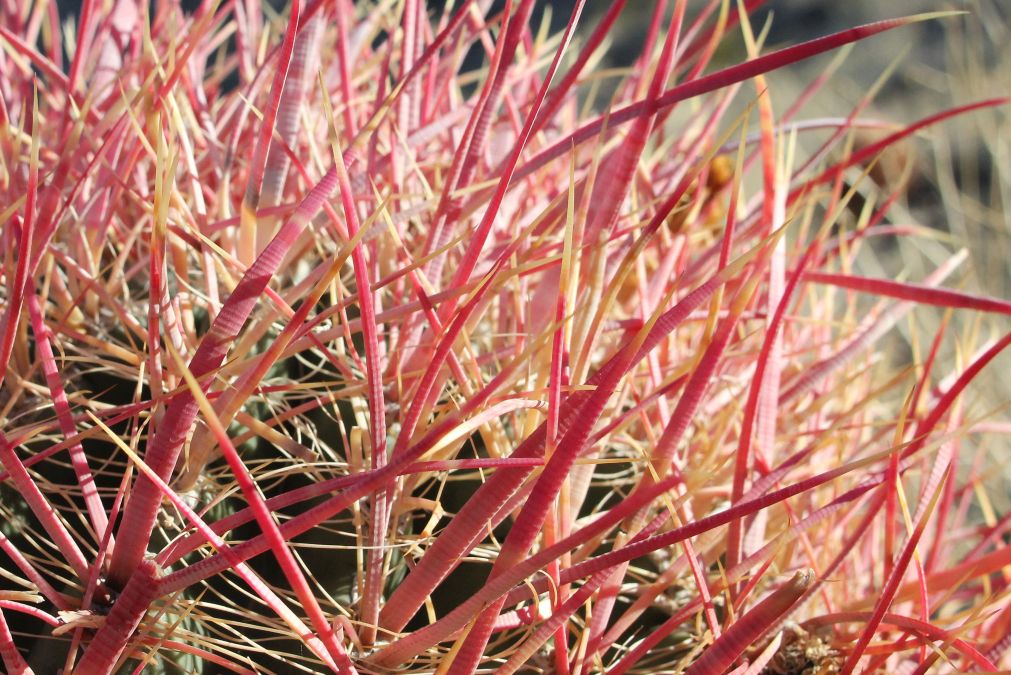
(Photograph = Ferocactus spines, David Wicks)
Introduction
Cacti are built for drought—sometimes months of it—often paired with 90–100 °F heat. Their forms aren’t just striking; they’re solutions. What looks like sculpture is actually water storage in the stem, night-breathing metabolism, and a skin that slows evaporation. The shapes we admire are the shapes that endure.
The Details
Spheres and columns make sense in dry country: they pack a lot of volume behind a small surface, which helps a plant hold water longer. Many cacti go one step further with accordion-like ribs that let stems swell after rain, then contract without tearing the skin. Most species photosynthesize in their stems and open stomata mainly at night (CAM), trading quick growth for water savings. A waxy, cuticle-covered epidermis finishes the job by throttling loss during hot, windy afternoons.
Spines are more than barbs. They shade the stem, slow air movement at the surface, and in some settings even comb moisture from fog or dew. All spines and flowers arise from areoles—tiny, specialized shoot structures that mark a plant as a true cactus. In opuntias, many areoles also carry glochids, those short, barbed bristles that make a brush with a pad so memorable.
“Desert cactus” is a useful shorthand, but it hides range and nuance. Plenty of species live in seasonally dry grasslands, scrub, and rocky breaks where storms arrive in brief pulses. There, the playbook is the same: catch light with stem surface—flat cladodes in prickly pears, cylinders in hedgehogs and barrels—store what you can, then wait out the gap between rains. The matte, bloom-dusted look on many species is part optics, part sunscreen, and part water-saver.
For growers, the lesson is simple and forgiving: think sun, lean mineral soil, and ruthless drainage. Water in distinct pulses, then let the mix go bone-dry; keep winter on the dry, airy side. If you plant near paths, give the spiny ones room, and remember that “impossible” beauty—the tight sphere, the ribbed column, the flower that opens after a long wait—is just good engineering wearing a little dust and light.
Additional Reading: Shapes of Cacti


