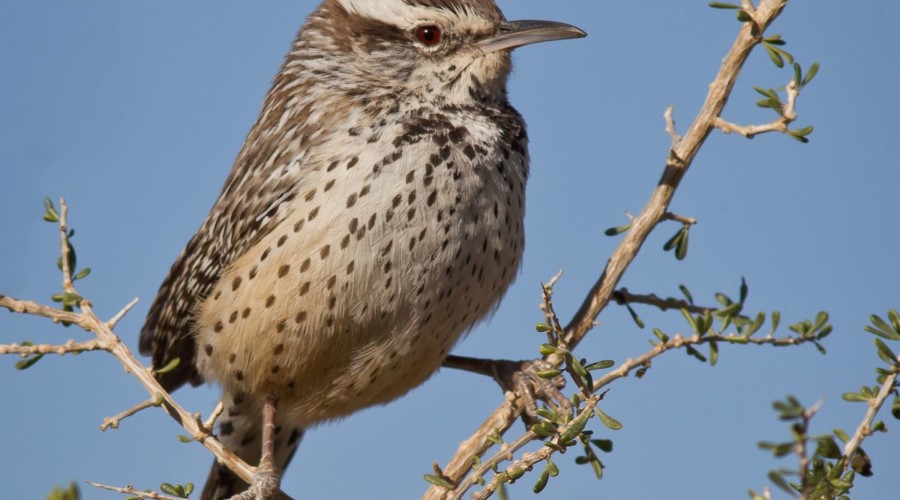
(Photograph = Cactus wren, Gerry)
Introduction
Among desert birds, the cactus wren is the loud neighbor—the one that announces itself, then stays to investigate your hat, your tripod, and your pack. It thrives where sun, wind, and spines rule the day, moving easily through cholla thickets, prickly-pear patches, and yucca stands. Bold, curious, and busy from first light, it rarely sits still for long.
The Details
Look for the bold white eyebrow, the speckled chest, and the long tail carried slightly cocked. The call is rough and insistent—more of a scratchy chant than a clear whistle—and it carries across open ground. Pairs keep loose territories year-round, and they make their presence known, chasing intruders with a quick burst of wings and a scolding glide.
Nesting shows the cactus wren at its most ingenious. The birds build football-shaped nests with a side entrance, tucking them deep into cholla, prickly pear, or yucca where spines do the guarding. A pair may maintain several nests at once—an active one for the current brood, and others as decoys or roosts—shifting between them as the season advances. Even when you can’t see a bird, you’ll spot the architecture: a woven, domed bundle threaded with grass, bark strips, and plant fibers.
Feeding is workmanlike. Wrens hop from shadow to shadow, flipping leaves, probing bark, and peering into cactus pads for insects, spiders, and the occasional lizard hatchling. When fruit is ripe, they take cactus pulp and seeds; when flowers open, they grab beetles and bees, then move on before the spines become a problem. In yards at the desert’s edge, they adapt readily—provided there’s a patch of spiny cover, a tangle of native shrubs, and a steady supply of small invertebrates.
If you’re scouting, start early, when the light is low and the birds are most vocal. Work the margins of cholla gardens, the edges of wash banks, and the bases of yuccas; listen for that rasping call, then watch for a quick tail flick and a hop to a more open perch. For photos, take a wide shot for habitat, then a closer view of the bird on its chosen cactus—spines and silhouette tell the story as well as plumage.
Small choices in the landscape matter. A cluster of chollas, a few native shrubs, and a promise to go easy on pesticides will bring more life to the same patch of ground. In return, the cactus wren will offer daily theater—nest inspections, loud opinions, and constant motion—proof that desert birds reward a little patience, and a little respect for spines.
Additional Reading: What Is a Desert Bird


Share this:
- Click to share on Facebook (Opens in new window) Facebook
- Click to share on X (Opens in new window) X
- Click to share on Pinterest (Opens in new window) Pinterest
- More
- Click to share on LinkedIn (Opens in new window) LinkedIn
- Click to share on WhatsApp (Opens in new window) WhatsApp
- Click to print (Opens in new window) Print
- Click to share on Reddit (Opens in new window) Reddit
- Click to share on Tumblr (Opens in new window) Tumblr
- Click to email a link to a friend (Opens in new window) Email
