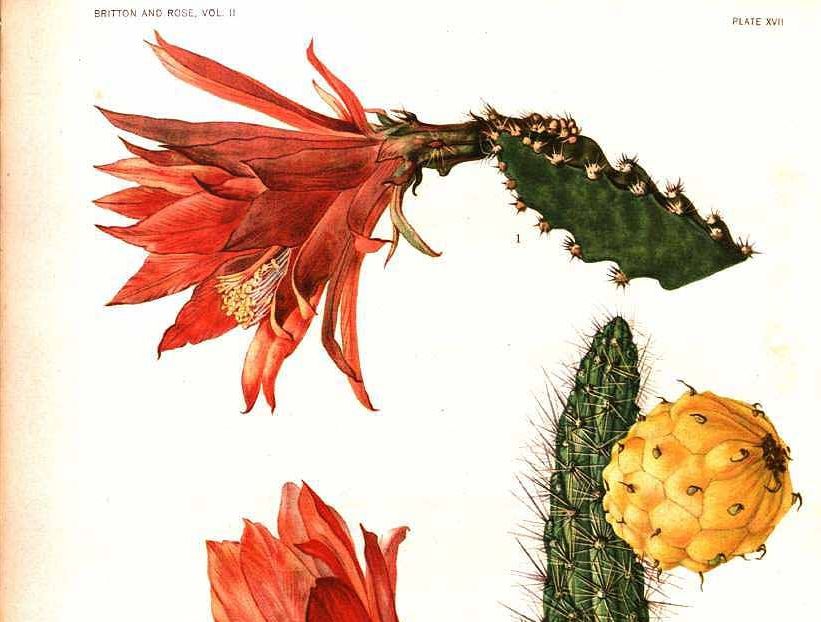
(Photograph = Plate XVII, Britton and Rose, Mary Emily Eaton)
Introduction
Before color photography, people could appreciate the colors of distant places and objects only through paintings and hand-colored prints. Botanical illustration was essential to early herbals and cookbooks, providing information that could be shared across languages and generations and serving as a practical guide for identification and use. Artists relied on careful observation, standardized conventions, and laborious techniques such as copperplate engraving, woodcut, and later chromolithography.
As scientific standards rose and demanded greater precision, artists made their drawings and paintings increasingly realistic, adding diagnostic details, scale indicators, and palettes matched to living specimens.
The Details
Mary Emily Eaton (1873–1961) was born on 27 November 1873 in Coleford, Gloucestershire, England. She is best known as a botanical artist for her illustrations in The Cactaceae (Britton and Rose, 1919–1923, vols. 1–4), for which she was the principal illustrator.
Ms. Eaton was employed by the New York Botanical Garden from about 1911 to 1932. Her illustrations appear in National Geographic magazine and in Contributions from the U.S. National Herbarium. Full-size PDF drawings of many kinds of plants are available at Plant Illustrations.
Additional Reading: Drawing Plants



Nice!!!!!!