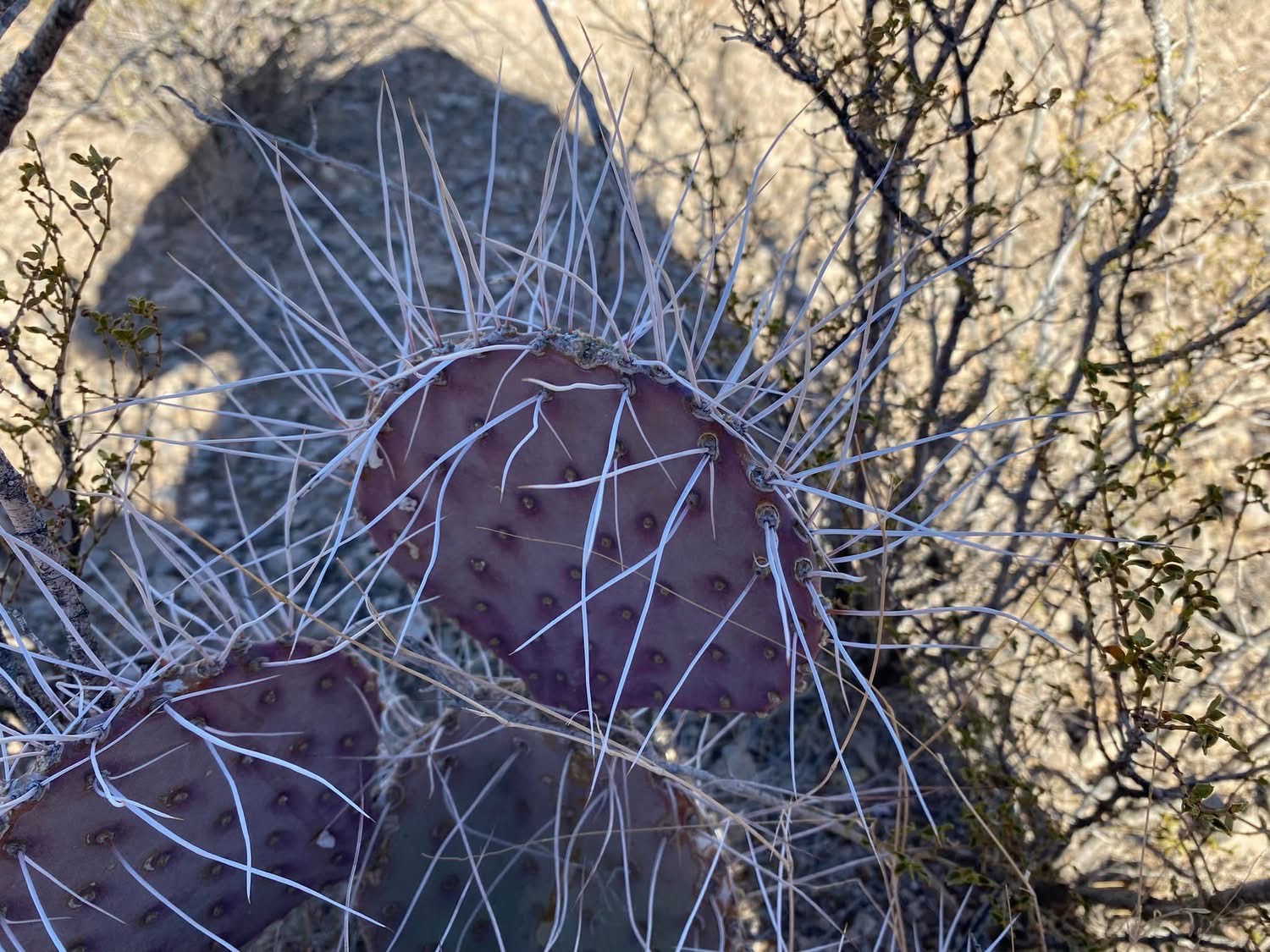
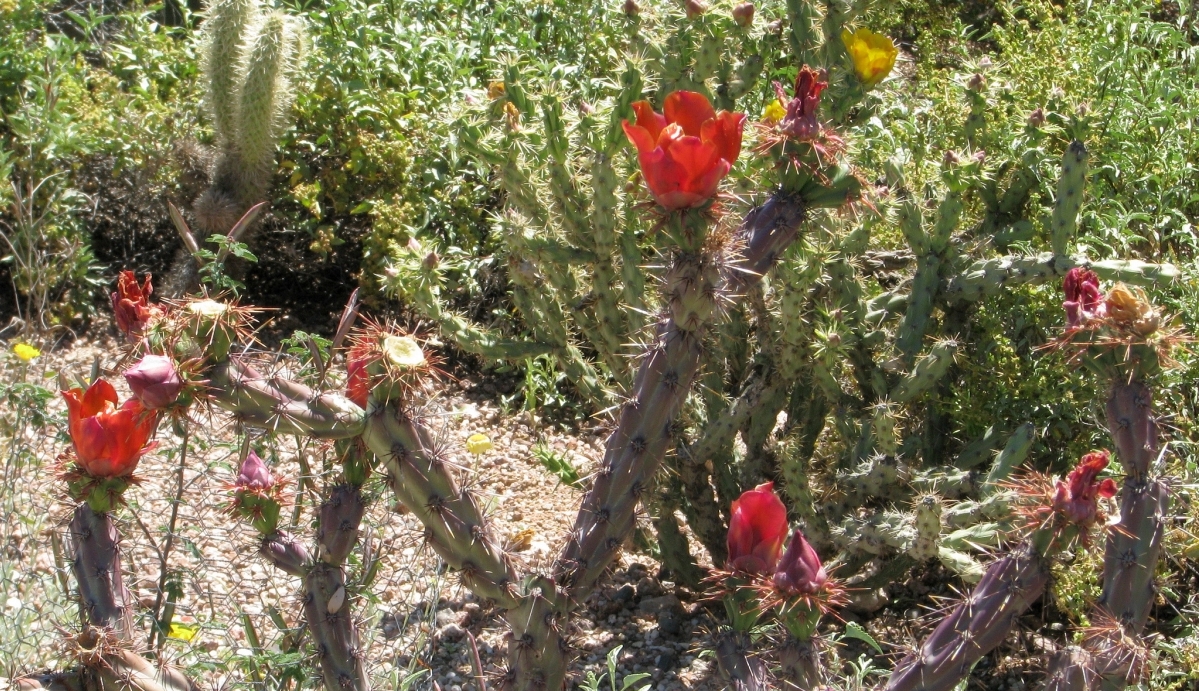
(Photograph = Corynopuntia clavata)
Introduction
Corynopuntia (Grusonia) clavata—club cholla—is a low, clumping opuntioid that hugs hot, open ground across parts of the Southwest and northern Mexico. Short, club-shaped segments stack into tight mounds, bristling with spines and glochids that warn off boots, paws, and curious hands. Plants are scattered, often local, and strongly tied to mineral soils—caliche, limestone chips, gypsum flats, and coarse sands. When spring turns warm, flowers rise at the tips and look almost oversized on such compact bodies.
The Details
Segments are cylindrical to club-shaped and only a few centimeters long, with distinct tubercles and closely spaced areoles. Spines vary in number and length, but even modest plants carry enough armament to mask the stem; colors run from straw and gray to brown, sometimes with a pale bloom. Glochids are abundant, and they detach easily, so handle with long tongs and slow movement.
Flowers open at the segment tips on new growth. Colors range from pale yellow to yellow-green, sometimes with a faint blush, and the petals have a satin sheen in strong light. Fruits dry at maturity and break down without turning fleshy. Seeds are relatively large and few, a common pattern in the group.
In the field, microhabitat matters. You may walk a mile of sandy wash and see nothing, then hit a stony bench and find scattered cushions occupying every sunny pocket with just the right drainage. Look on slight rises, road cuts, and the shoulders of low terraces—anywhere water sheds quickly and the soil warms fast.
Identification centers on segment shape and armament: short, clubby joints; dense spination that projects out rather than lying flat; and a tidy apex where the season’s growth and next season’s buds concentrate. Related taxa can be taller, looser, or longer-jointed, but C. clavata keeps its proportions compact and close to the ground.
Cultivation, briefly. Success comes down to heat, light, and a very mineral mix. Use a deep pot with large drainage holes and a gritty substrate—pumice, coarse sand, and a little lean soil. Water deeply, then let the mix dry almost completely before the next soak; in cool weather, keep nearly dry. Full sun and moving air produce the tightest growth and best color. In wet-winter climates, grow in containers or raised beds to keep crowns high and quick-draining.
Safety and placement. Spines and glochids mean business. Give plants elbow room away from paths, play areas, and hose work, and stage containers where you can admire the form without brushing past it. A light gravel top-dress keeps the crown clean and shows off the compact geometry.
Club cholla rewards close looking. From a distance, you see a bristling mound; up close, you notice the neat tubercles, the precise areoles, and, in season, satin flowers perched above armor. Kept sunny, gritty, and on the dry side, Corynopuntia (Grusonia) clavata stays tight, colorful, and true to character.
Additional Reading: Original Description (as Opuntia clavata).