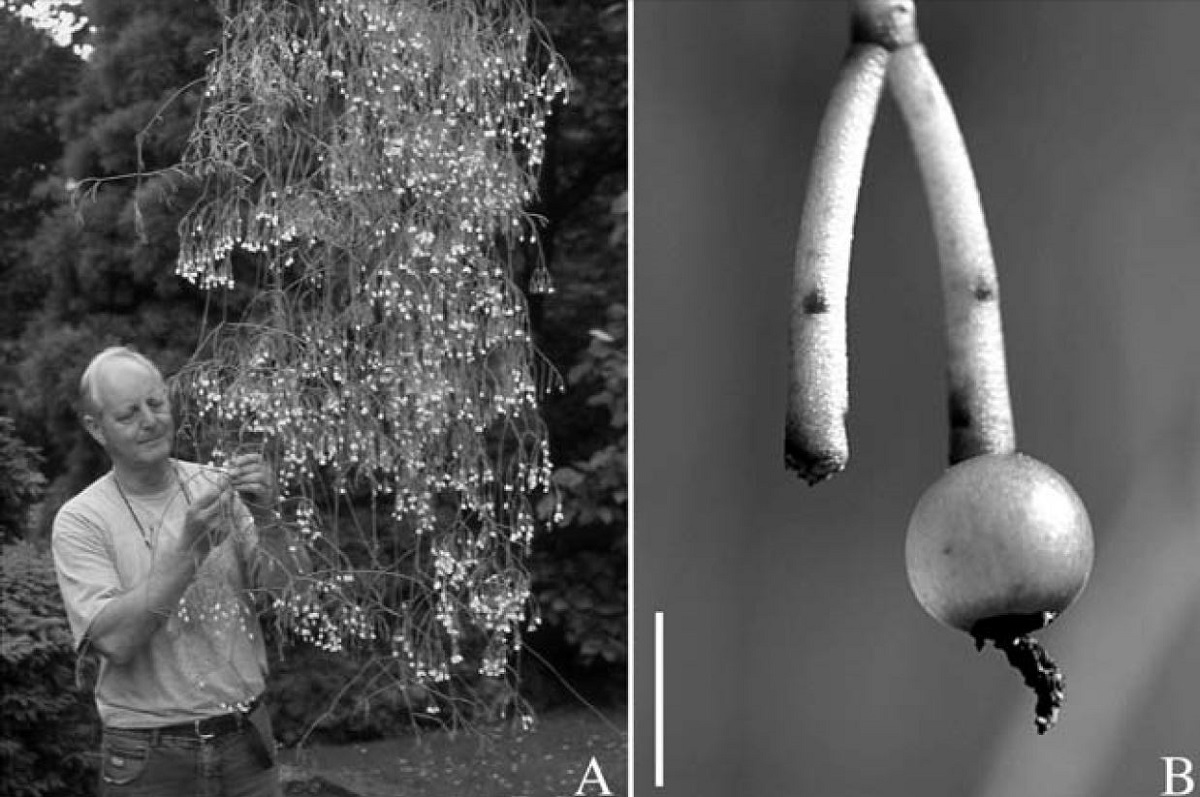
(Photograph = R. juengeri with greenish fruit)
Introduction
A new species of Rhipsalis—R. juengeri—was described from the Atlantic Rainforest in eastern Brazil. It forms more than three-meter curtains that hang from the canopy. At the tips of the thin, pendant shoots it bears small, greenish berries that, unusually for a cactus, are strongly scented with a black-currant–like aroma. The scent, rather than bright color, is the plant’s main signal.
The Details
Because the fruits are dull green to light beige—not the red or white that typically attract birds—their strong, berry-like odor likely targets animals that rely more on smell than on color. The leading candidate is a bat. Bats are active at night, they have keen olfaction, and they commonly feed on soft fruits in the forest canopy.
Several fruit traits fit that idea. The berries develop and are presented at the very tips of long, hanging shoots, where a flying mammal could easily pluck them. Ripe fruits can persist on the plant for weeks to months and remain aromatic the whole time, increasing the chance that a nocturnal frugivore finds them. Each fruit carries only a few seeds, which is typical of animal-dispersed plants that “package” seeds in small, frequent servings rather than in large, colorful crops meant for birds.
This is still a hypothesis, but it is a reasonable one: a scented, canopy-hung fruit could feed bats, and in return the bats could deposit seeds on branches or trunk surfaces—exactly where an epiphytic cactus needs to start life.
Additional Reading: A Cactus with Scented and Possibly Bat-Dispersed Fruits