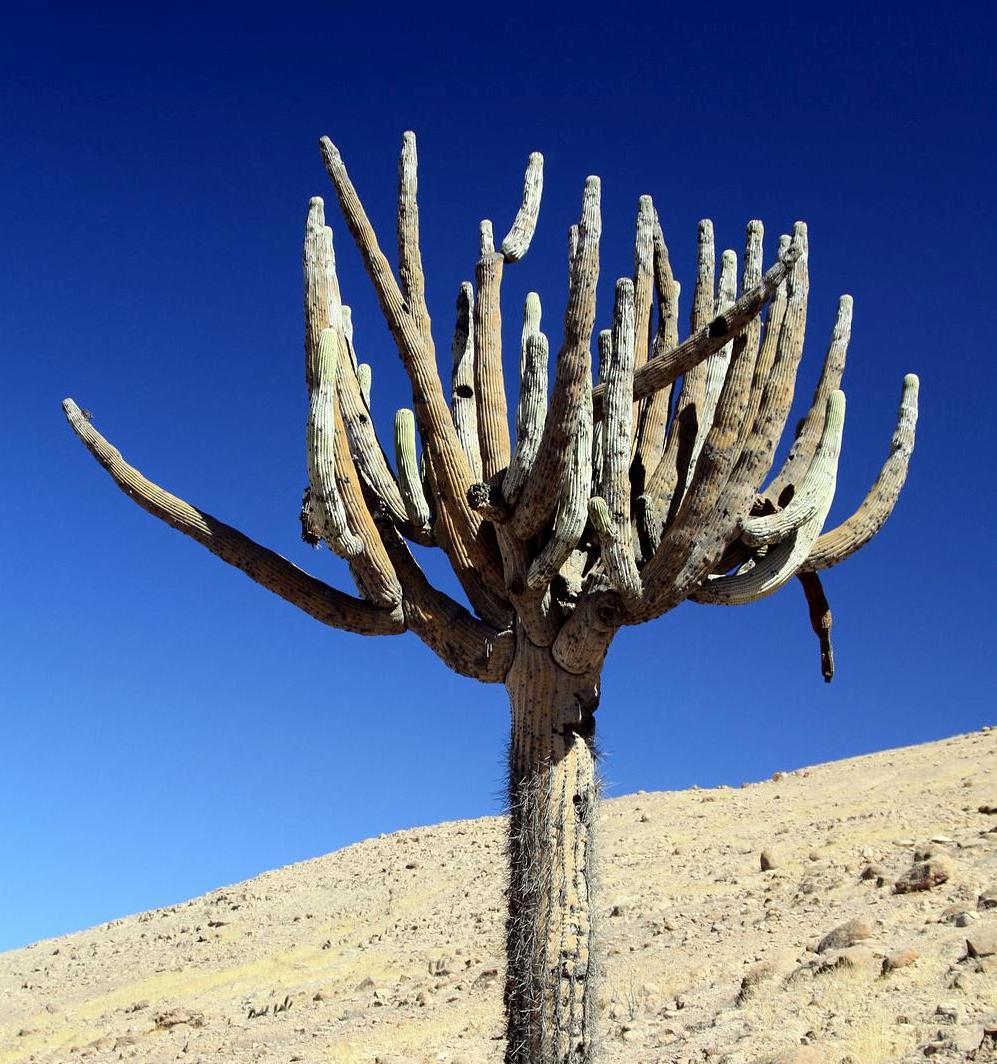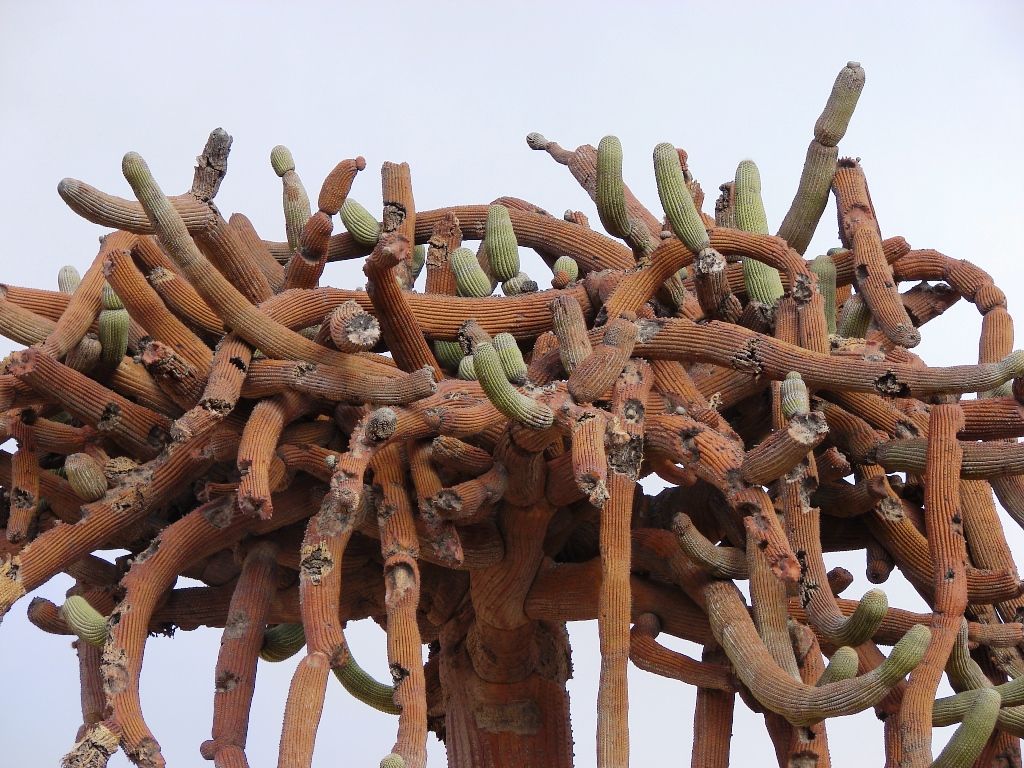
(Photograph = Browningia candelaris, Pato Novoa)
Introduction
Columnar cacti captivate with bold, architectural forms and sparse branching. Some exceed 15 m (50 ft), and the largest species dominate their landscapes. Their tall, ribbed stems act as living cisterns, swelling after rare rains and contracting during drought. Spines cast fine shade and break the wind, while thick skins limit water loss. Many grow slowly and live for centuries, shaping desert vistas and providing shelter, nectar, and perches for wildlife. From lowland deserts to high Andean slopes, these sentinels define place—and few are more dramatic than Browningia candelaris.
The Details
Browningia candelaris is a striking columnar cactus with a solitary, heavily spined trunk that rises like a column. Near the apex—typically around 2–3 m—the trunk gives way to a small crown of stout branches, producing the classic candelabrum silhouette. The contrast is vivid: the lower trunk is deeply ribbed and armored with long, formidable spines, while the upper branches are comparatively smooth, with shorter spines and tighter areoles. This age-related shift likely balances defense, hydraulics, and light capture as the plant transitions from juvenile to reproductive form.
Plants are usually widely spaced individuals rather than dense stands, accentuating the starkness of their setting. They occupy rocky slopes, talus, and cliffy shelves on the dry western flanks of the Andes, from northern Chile into southern Peru. Elevations are high enough for large day–night temperature swings, strong winds, and intense sun. Rainfall is scant and erratic; runoff vanishes quickly through coarse, stony substrates. Ribs allow the stem to expand and contract without tearing, the thick cuticle limits transpiration, and the dense spine cloak shades the epidermis and disrupts boundary layers, reducing heat load.
Flowering occurs on the branches, not on the spiny trunk. The flowers are white and open at night—an adaptation to cool, dry air and nocturnal pollinators. Blooms are typically produced in mid to late winter (July–August in the southern hemisphere). The flowers are tubular to funnel-shaped and often scented, consistent with visits by night-flying insects and, in some sites, possibly nectar-feeding bats. Fleshy fruits follow, packed with many small seeds. Birds and small mammals likely disperse these seeds as they forage, depositing them into cracks and litter pockets where rare moisture can persist.
Growth is slow, and recruitment is episodic. Seedlings establish best in shaded crevices or beneath stones that buffer heat and evaporative stress. As individuals mature, their branching crown casts a modest “island of shade,” trapping windblown litter and creating a cooler, slightly moister microsite at the base—a tiny refuge for crusts, lichens, and occasional herbs. The plant’s architecture thus engineers its own niche while offering perches and shelter to wildlife in an otherwise austere habitat.
Because Browningia candelaris depends on infrequent wet years for regeneration, disturbances that remove adults or crusted soils can outpace natural recovery. Road building, mining, and trampling on fragile slopes reduce establishment sites; prolonged drought further narrows the window for successful recruitment. The species’ towering stature and long life offer resilience against short-term stress, but population turnover is slow. Protecting intact rocky habitats—and the subtle microenvironments where seedlings take hold—is essential to the long-term persistence of these high Andean candelabras.
Additional Reading: Browningia candelaris