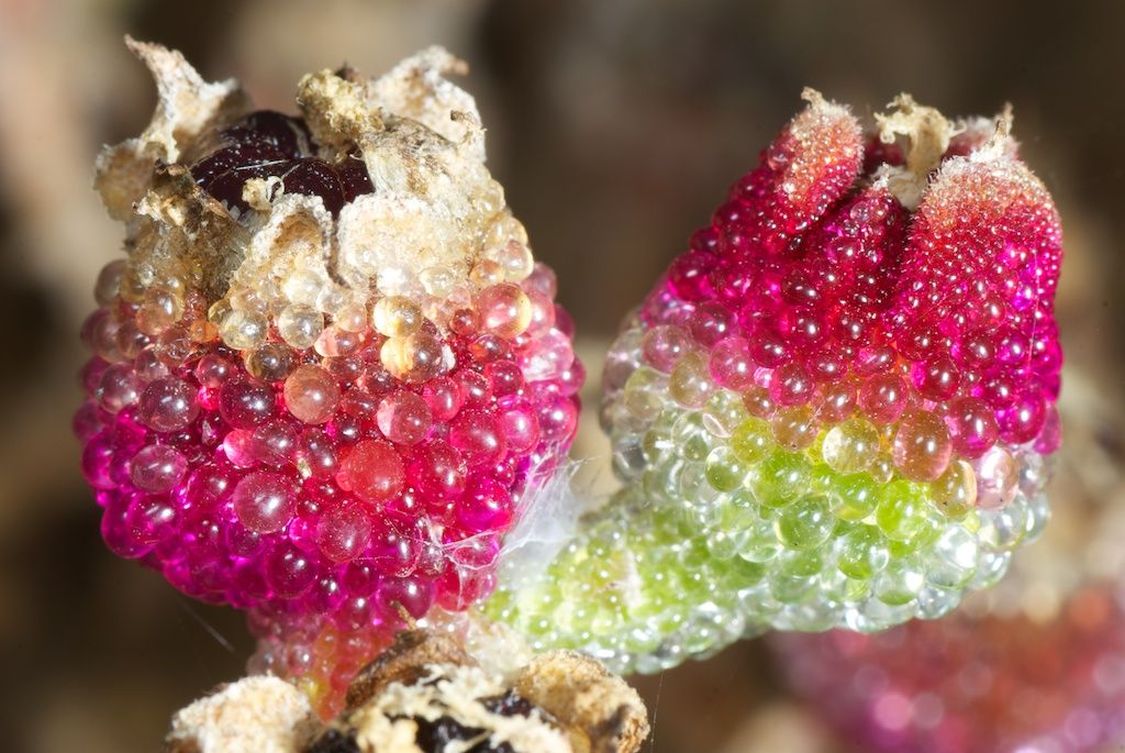
(Photograph = Mesembryanthemum crystallinum seed pods, Jon Sullivan)
The Details
M. crystallinum has spread to other continents and now even grows in the Atacama Desert, where it benefits from close association with the cactus Eulychnia acida. Soil beneath E. acida holds more plant-available nutrients (N, P, K), more water, and more soluble salts than adjacent open ground. In one field study, M. crystallinum plants growing under E. acida produced roughly four times the above-ground biomass of plants growing away from the cactus. In relatively undisturbed shrublands, the ice plant is scarce except near E. acida, which functions as a nurse—moderating heat and evaporation while enriching the small “islands of fertility” beneath its canopy.
A few traits help explain this success. Under stress, M. crystallinum can switch from C3 photosynthesis to CAM, conserving water; it also tolerates and stores salts in its tissues. In coastal Atacama sites, frequent fog adds a bit of moisture that the cactus and its understory plants can exploit. Over time, stands of M. crystallinum may increase salt levels in the topsoil, which can further shift plant competition in their favor.
Additional Reading: Mesembryanthemum crystallinum and Eulychnia acida in the Atacama Desert


What a stunning little plant. Thanks for the post. Carol