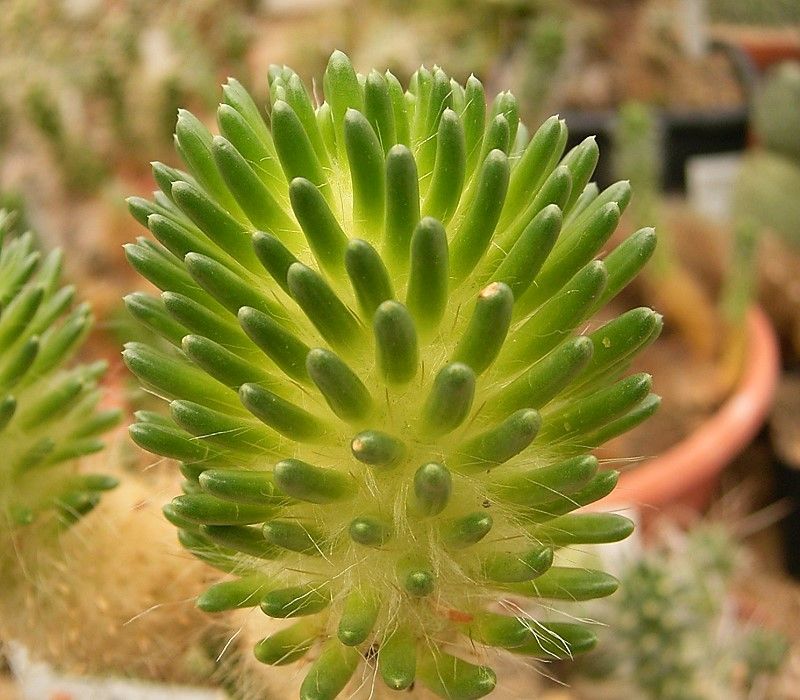
(Photo above: Punotia lagopus in cultivation, Eigenes Werk)
Introduction
The Details
As we climbed above 4100 metres above sea level (asl) we noted some of the clumps of hairy cacti began to look slightly different. Amongst the small clumps of Austrocylindropuntia floccosa and the occasional Echinopsis maximilliana we found our first specimens of Punotia lagopus on a flat grazed patch of land. Further on, at around 4300m altitude we found larger specimens, some up to almost 2 metres in diameter, in very dark and wet peaty ground. At this site some of the plants were almost growing into the river. One plant had been uprooted and turned over. Looking at the underside we could confirm these large clumps of stems are all one plant with branches spreading radially from one central, rooted stem.
The following morning, after spending the night in Macusani, we drove back through the pass stopping at the highest point, just over 4686 metres asl.. The plants here were covered with a light sprinkling of snow which had fallen in the night. By mid morning it had melted completely. Cacti here were growing on East facing gentle slopes of short grass. Only A floccosa and P lagopus grew here making this, I believe, the highest location recorded for cacti.
Wikipedia reports that the word lagopus is derived from Greek and means “hare (rabbit) foot.” And the fluffy white cladodes do resemble a rabbit’s foot. Punotia lagopus (formerly, Austrocylindropuntia lagopus) can be found near La Paz, Bolivia, at altitudes from 4,000 m (2.4 mi) to 4,700 m (2.9 mi).
The cacti make intricately branched shrubs, and the cladodes are densely covered with hairs up to 2 or more cm-long. The hairs may protect from cold and UV radiation at that altitude. The low shape may allow the plants to absorb heat from the ground and avoid the wind. The dome shape may be caused, in part, by wind pruning, which “removes” plant parts that stand out against a silhouette.
Additional Reading: Cactus Explorer 16–High Altitude Cacti